Bethlehem – Church of Nativity

Day 6. The morning was all about the location where Christ was born. The Church of the Nativity was built by Helena, mother of Emperor Constantine, in 339 AD. Two sets of steps besides the main altar lead down into the grotto, where Jesus was born. The spot is marked by a large silver Star emblem embedded in white marble in the ground.

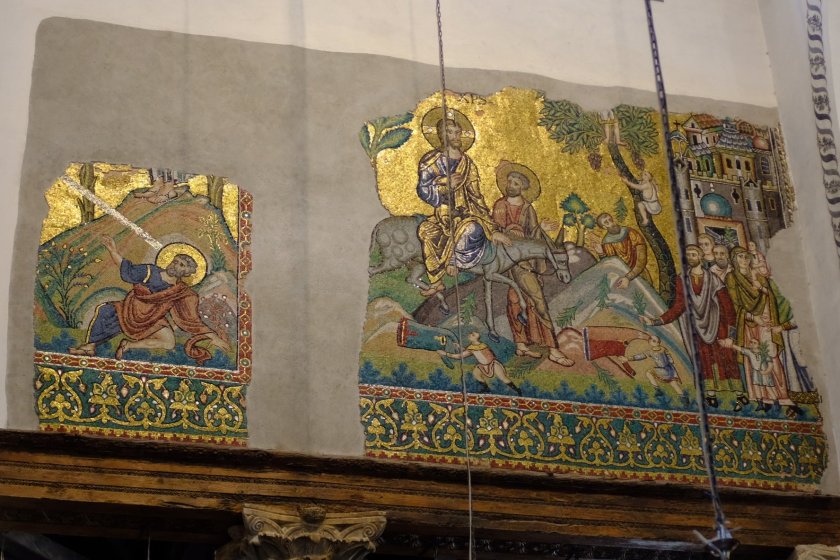
The crowds are massive. As one winds one’s way inside the Church, there are amazing mosaics on the walls, and painted columns.
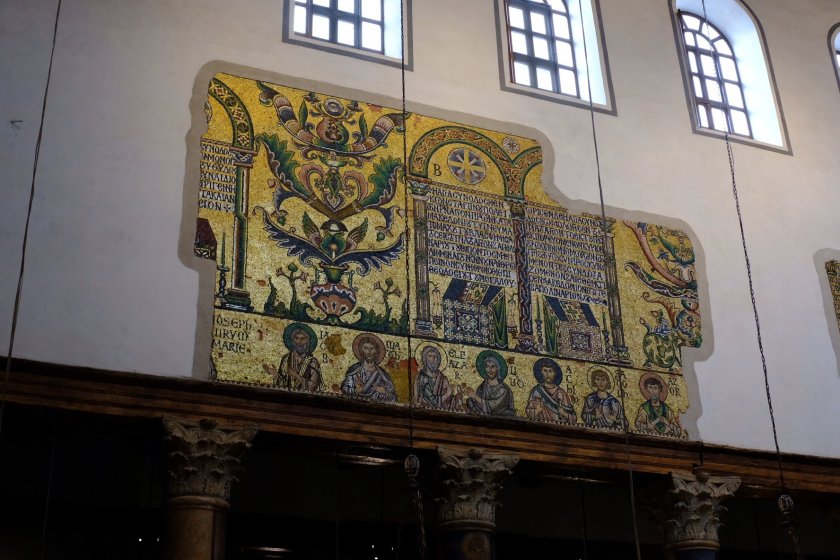
In the main part of Church
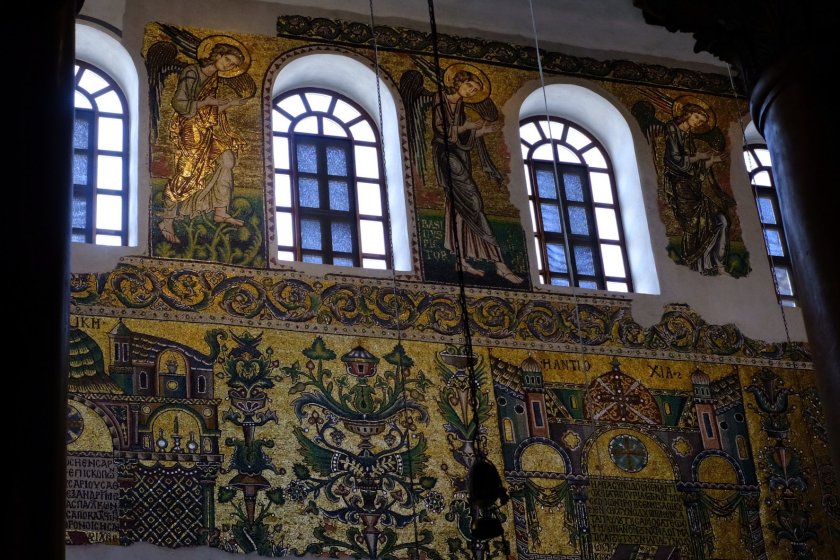
Still in main part of Church
Approaching the grotto (side of Church)

During a Pilgrimage, tests can be appear in different forms and shapes

What would one’s temperament normally be when one has to line up for 2.5 hours for a distance of about 200 meters?

During tests, the goal is to remain spiritually calm and centered. Be courteous despite any pushing or line cutting. Engage in fellowship with your companions in the line. Read scripture on your smartphone. Listen to Christian music. Pray (the rosary)!

One member within our group was an elderly lady who needed a cane to walk and could definitely not wait in a crowd for 2.5 hours. Our tour guide escorted her down the exit steps. Some who were exiting shamed her verbally. Clearly, Compassion was needed, not human judgment. She blessed them in return. Compassion and Grace sweetens our surroundings when exercised.

Figure out what works for you, for this and other future situations. It’s a tool that will come handy in life.

Silver Star marks the location revered as the site Jesus was born

Joon bending down, while Ben is getting to her side.
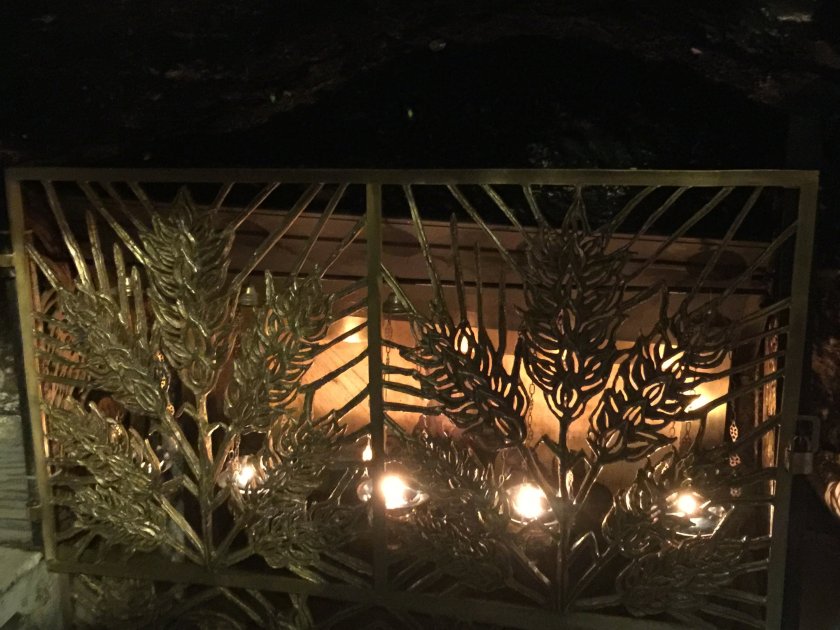
The Manger site

Here’s a hard question. We celebrate Christ’s birth on Christmas Day. Why the need to visit the spot of His birth? Consider this – People visit the preserved homes of past Statesmen or famous personalities, e.g. George Washington’s Mount Vernon estate or Elvis Presley’s Graceland. Christ never had a home but tradition and history had recorded his birth site. In that regard, visiting this site pays homage to Christ. Furthermore, God is the Master of Time. Isn’t it conceivable that our reverence at this same spot may appear historical from our human condition, BUT is present in His Time?

A thought occurred to me a couple of days after this visit to the Church of Nativity. What would our perceptions and experiences be if there were no crowds and lines? If we had just walked up to it? Is the waiting, part of the homage offering?

My memory-seed for this visit would be gratitude beyond measure.

The next and final visit would be the Shepherd’s Field, where the Angels appeared to the shepherds.
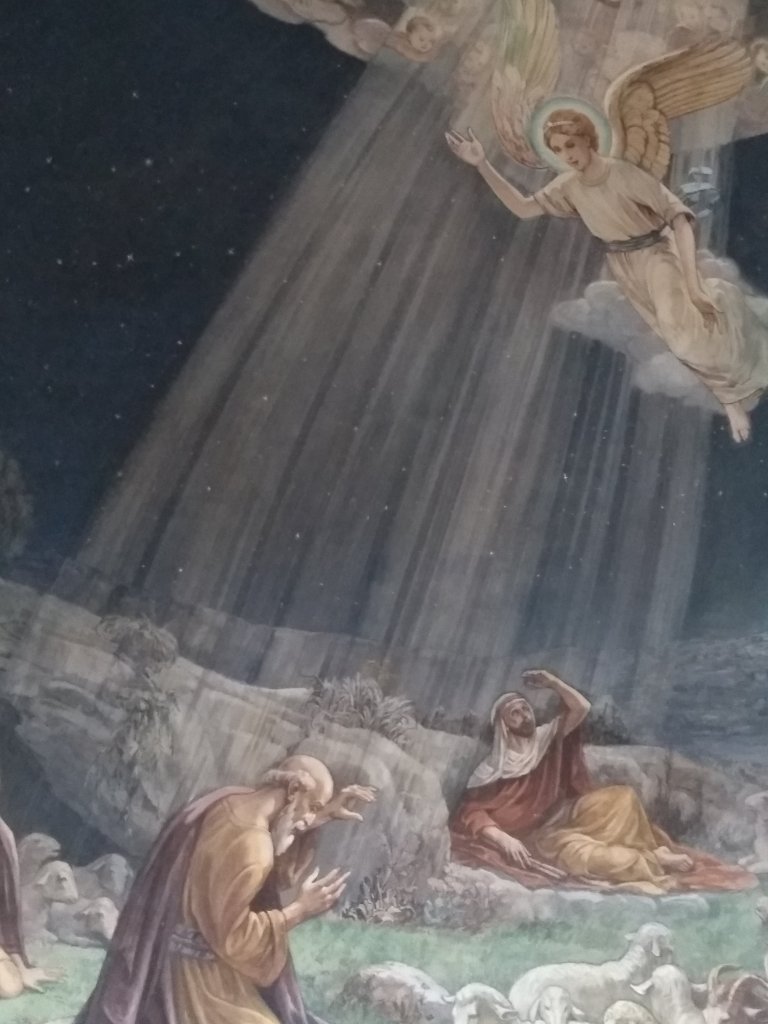
A wall mural depicting the Angels approaching the shepherds.

Inside the domed structure.

How would Men in general react and respond if Angels appear once again in today’s world? What have we lost in the name of human centered progress?
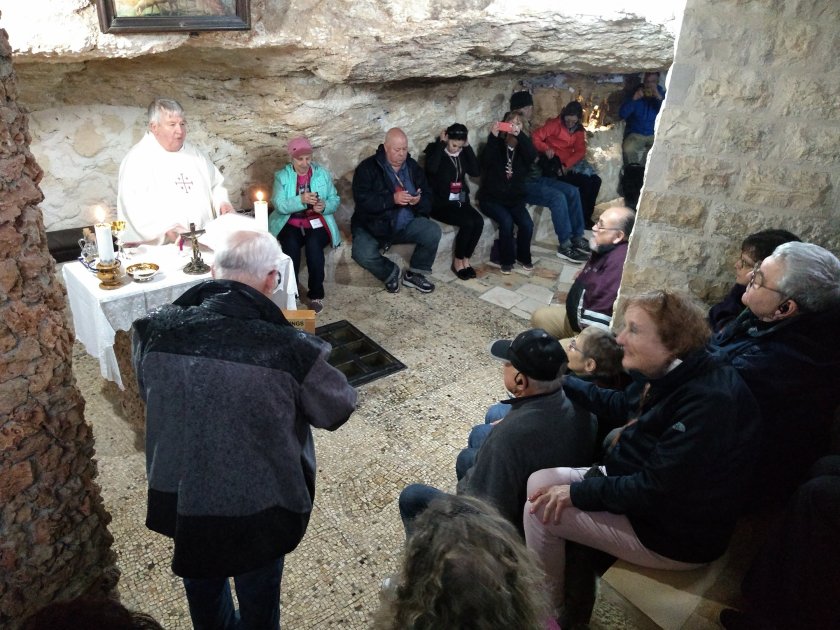
Today’s Mass was in a grotto at Shepherd’s Field.

PostScript: My T-Mobile One service plan had worked seamlessly in Tel Aviv, Nazareth and Bethlehem, until we crossed over to the West Bank. At that point, the plan no longer applied and additional international roaming charges would be incurred. Ouch.
Observations and Reflections

After 2,000 years, all the towns and villages are very much developed. Construction continues healthily as we spied several cranes. Most structures in the Holy Land are either two or three stories high, exception being governmental or military related complexes.

There’s a uniform sandstone coloration as they use local stones and rocks that do NOT need to be painted. The weather is such that it doesn’t seem to cause any discoloration. Very green, and not a market for the paint companies.

Traffic flows as there seems to be a tacit understanding when to give way. While there’s a bit of vehicle horning taking place, it’s the ‘polite’ horning that can be easily differentiated from the ‘angry’ variety.

The food being served in the hotel buffets abound with vegetarian options, prepared Mediterranean style. We had indulged too much in the desserts, leading to a waist stress. It was an easy decision for me to forgo future desserts. I had read somewhere that for some situations, it’s easier to totally abstain than attempting to moderate step by step. I get to also exercise self discipline.

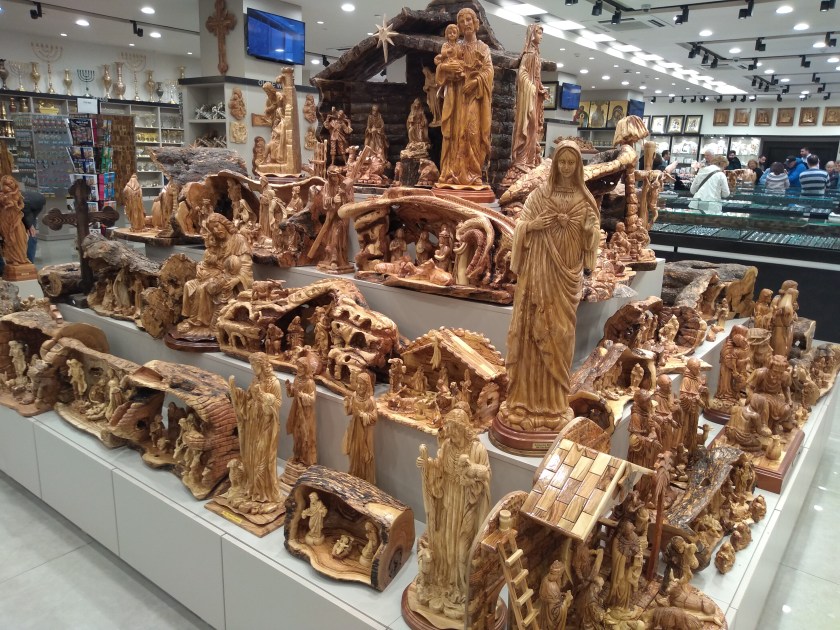
Our guide had been encouraging us to defer any purchases until Bethlehem. He claimed that most of the handicraft in other towns and villages are made in China. In addition, he was bringing us to a shop run as a cooperative where 64 Christian families are handcrafting their works. The olive wood art pieces are truly beautiful. We made some purchases.

Prices in the majority of shops and cafes in touristic locations in the Holy Land are in USD. One time, I over paid in New Israeli Shekels (NIS) for a simple vegetarian falafel. The change was in USD dollars.

Pricing is about and sometimes above USA levels. Perhaps one of the reasons is the appreciation of the NIS. I did wander into two local grocery stores in Bethlehem as latter’s hotel was more centrally located. Things were priced in NIS and much more reasonable.

The number of large tour groups is very high. It seems we are in the peak season in March, as it’s cooler than summer. One option is participating in a small tour group of 6 or less. This allows said smaller group to skip the long lines at the Church of the Nativity (it took us 3 hours from start to end!).

Mt. Tabor & Jericho

Day 5. This morning was a test of patience as we waited to board shuttle vans to the top of Mt. Tabor, and for the return ride (at least 45 mins wait each time). It seemed that many tours schedules had this in their itinerary today. Isn’t a Pilgrimage, one that sharpens various virtues?

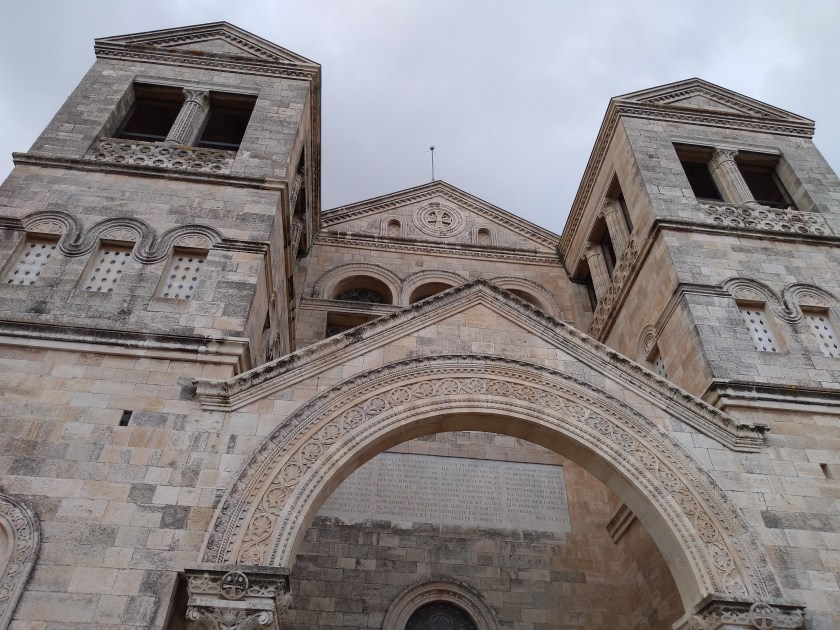
The architect, Antonio Barlucci, designed his first church here, the Church of the Transfiguration. The facade reflects the three tents offered by the disciples, to shelter Jesus, Elijah and Moses.

Facade of the Church of the Transfiguration

The Greek root word for the translation Transfiguration is metamorphor. As in a butterfly’s metamorphosis from a caterpillar. But in Christ’s case, the Transfiguration revealed His inner Divinity. Can we have our own form of transfiguration as the Holy Spirit in-dwells within us?

Inner sanctum and altar

The upper level is flanked by two sanctuaries, dedicated to the Holy Spirit (dove) and the Father (eye).

It is said that the only constant is change. Further, literature abounds with references to the inner beauty within each of us, and releasing our inner child. Matthew 18:3 “And He said, Amen I say to you, unless you change and become like little children, you shall not enter into the Kingdom of Heaven.” Ergo, let’s transfigure from within.

We proceeded to Jericho, rescheduling the visit to the baptismal site on Jordan River due to the delay at Mt. Tabor. Jericho is the lowest city in the world, 250 meters below sea level. The tree that Zachhaeus climbed to see Jesus is still standing!

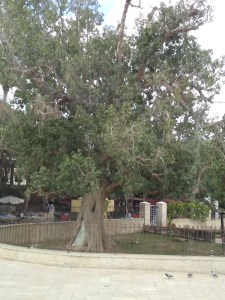
Zachhaeus tree

Being able to attend Mass daily with fellow parishioners, conducted by our Parish Priest, Father Jim Coyne, has been a blessing. The readings and sermons are relevant to the location.

Father Jim at Church of the Good Shepherd.

We skipped lunch today, as three days and nights of buffet breakfasts and dinners have taken their toll. It’s easy to feel when the physical body is imbalanced. Let’s pray that this Pilgrimage sharpens our sense of spiritual imbalance.

Nazareth and Cana

Day 4. The Basilica of the Annunciation in Nazareth was built over the home of the Virgin Mary, where the angel Gabriel appeared. Along an exterior corridor and inside the Basilica, are artwork of the Virgin Mary, donated by churches from various countries. There was a sublime beauty to these artwork. The Virgin Mary plays an important intercessory role in the Catholic Church, given her multiple apparitions, such as at Fatima, Guadalupe, Lourdes, etc.

Donation from USA

Donation from Indonesia

It was unfortunate that access to the lower level was closed today, as we wanted to view the plaque where it’s written in Latin, ‘The Word was made flesh here’.

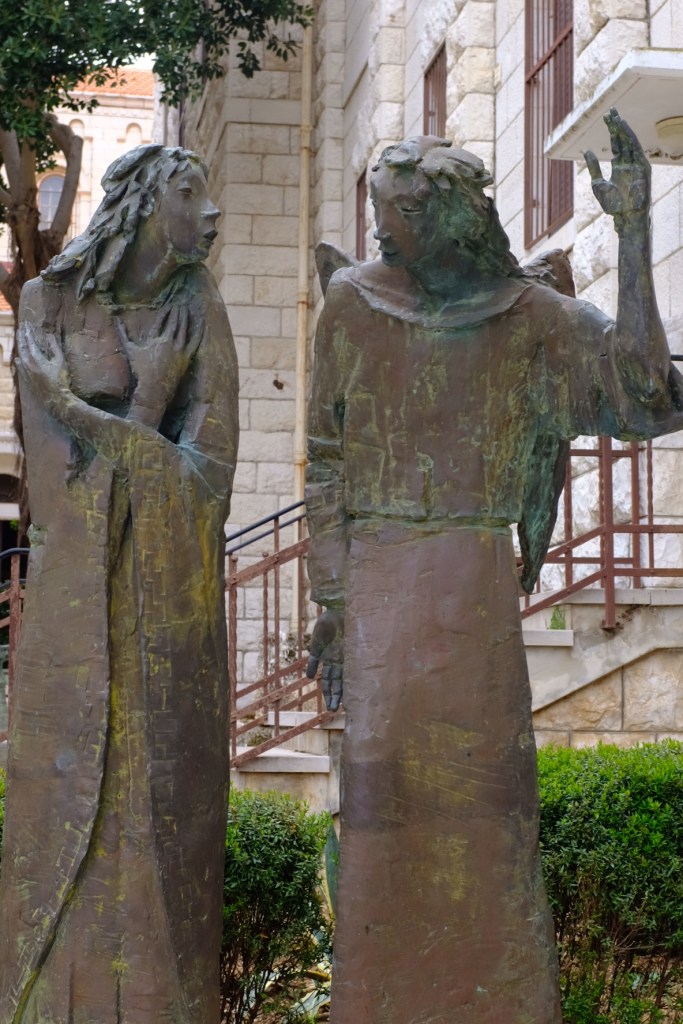
We adjourned next door to the church of St Joseph. The courtyard had a number of beautiful sculptures and plaques. This modern interpretation of the Annunciation was stunning.

Our Parish Priest re-iterated St Joseph’s obedient role in the caring of Mary and Jesus. And it seemed appropriate to pray for St Joseph and Mary’s intercession to acquire the parental wisdom and patience for our own families.

The highlight of today, made possible because we traveled with our Parish Priest, was renewing our wedding vows at the Church where Jesus performed his first miracle at Cana. This miracle was the changing of water into wine at a wedding celebration. There were 12 couples, with the longest marriage at 51 years. We will celebrate our 35th anniversary in May. Sharing a common faith bonds a couple beyond measure. We are blessed to have found each other.

I noticed the next group that has booked the chapel was conducting a wedding, with the bride in white and the groom in a suit! What a memorable location.

A late afternoon excursion to Hermon Stream (Banias) nature reserve brought us to the area where Peter was divinely inspired to answer Jesus question of who people said He was, with, ‘You are the Messiah, Son of the Living God’. There are great walking trails with waterfalls and a strong flowing river, fed by mountain snow.

Love conquers all things,

Let us too surrender to love.

Roman poet Virgil

Nazareth

Day 3 of our organized tour began in Nazareth. Like all organized tours, Day 1 & 2 is travel day, especially when it involves international flights. We were pleasantly reminded of this as we had made our own travel arrangements and arrived the day the tour was supposed to start based on the itinerary, but it was a day earlier than the rest of the tour group. This serendipitous situation allowed us to spend a day exploring Tel Aviv. Day 2 afternoon/evening was meeting up with the rest of the group at the airport and commuting to Nazareth for the night. As you can tell, this is probably our first tour package in a while (I vaguely recalled we may have taken one 35 years ago). We prefer to travel independently.

Nazareth is where we will spend our first three nights of our Holy Land Pilgrimage tour.

For the modern day pilgrims, there are several ‘risks’ that we must contend with. The first risk is that the crowds and some of their behaviors will likely influence one, as if one was a twig being tumbled along by a bubbling creek. There’s a rush to photograph the attraction. There’s a lot of posing by statues and selfies. There’s the invariable spill over chatter from tour leaders briefing nearby groups (we ourselves are guilty of that). Today’s smartphone camera is yesterday’s grafitti spray can.

The second risk is forgetting to don on the pilgrim’s glasses and hat. Good songs have a catchy beat and tune. Great songs marry meaningful words to the music. Likewise, a Pilgrimage experience marry what we ‘perceive’ with what we feel/sense and how that moves our inner self

My tips for the (Christian) Pilgrim are three fold:

1. Reflect and contemplate the religious significant of the location you are at. Give free reign to your imagination, heart and spirit.

2. Pray from within. Let that location’s significance move your heart. Give birth to that special intention.

3. Carry inside you a special memory-seed of the moments you spent there. It will germinate and flower in our life. In God’s time.

Our first visit was the Mount of Beatitudes (and where we caught our first sight of the Galilee Sea as we stood on terra firma). The church was built over the spot/area where the sermon was delivered. Having the Bible available on my smartphone allowed me to refer to the relevant scripture verses. It’s a lovely spot that one can easily spend an hour and immerse oneself. Imagine hearing Jesus preach those verses and just reflecting where and how these teachings apply to one’s life. My special intention and memory-seed was a specific beatitude that I desired to cultivate. For some, the message will be different. Unfortunately, as in all organized tours, the schedule dictates our ability to linger as our soul would like to.

The Church of the Multiplication of Loaves & Fishes was built over the rock where this miracle was performed. It really shouldn’t surprise any of us that we have all been multiplying our talents as we grew up and earned a living. The physical miracle should not be discounted. Perhaps the question to ourselves is where the largesse of our efforts have landed. Again, my specific prayer intention and memory-seed centered on this multiplication.

There is much symbolism that we might have easily overlooked if our guide, George had not mentioned. This church has a mosaic representation of four bread loaves and two fishes. But scripture refers to five loaves and two fishes. Did the artist make a mistake? No, he/she did not. The fifth loaf is represented by the hosts offered during Eucharist.

Magdala was a highlight. It’s an area found serendipitously as someone was building a resort. They found the runs of the oldest synagogue excavated in Galilee, one of seven first century synagogues. They found an intact stone base where the Torah would rest on. On the sides and top of the stone are intricate religious carvings.

Mary Magdalene came from this village, and Jesus very likely preached in the synagogue as it was located along the Via Maris, a major thoroughfare. Visualizing Jesus in the synagogue preaching and reading some scripture would be a powerful experience.

We celebrated Mass at a modern chapel with an altar designed like a fishing boat. This chapel was surrounded by a water moat, and the reflecting sunshine truly added special effects. I love the basement chapel with its original flooring and the painting. Below is just the central portion of said painting (only feet are depicted).

Faith heals.

Perhaps through Faith, one should seek self healing first, in all aspects, realized, hidden and spiritual. This is not selfish but recognition that one’s brokenness can only be truly healed by God.

I am excited as I see the construction taking place here as I can visualize how this center can lead to many fruits.

The Church of the Primacy of St. Peter on the shores of the Sea of Galilee was where Jesus prepared breakfast for the disciples after His Resurrection. The Church altar is built over the rocks where the fire was. It’s here where Jesus asks Peter three times whether Peter loves Jesus. Has God asked me three times or more on some specific Will of His?

We ended a packed day with a boat ride on the Sea of Galilee. Since the River Jordan flows through the Sea of Galilee onto the Dead Sea where it ends, our guide astutely noted the Sea of Galilee would be there widest part of the River.

The Sea had a thin layer of brownish algae one tree pollen. It was extremely calm. During one stage, birds that were floating on the Sea suddenly flew around our boat, circling our moving boat multiple times. I had a surreal sensation that we were being greeted on the Sea.

The boat crew played some Israeli music and let us in a group dance. Oolah lah.

Thus, the day ended. Mind and spirit renewed.

Selective Listening?

Today’s Lenten meditation makes it easy for all Christians to forgive. Will we listen?

“The three stages of forgiveness. I don’t deny what the person did, or pretend it wasn’t wrong. But …

1. Instead of identifying the person totally with whatever they did to hurt me, I begin to see them as a person like me – imperfect, but still someone God LOVES.

2. I give up my ‘right’ to get even. Vengeful thoughts don’t make the other person suffer. They hurt me. So, I just plain rinse my mind of those kinds of thoughts.

3. I stand next to the LORD and together WITH HIM, look at the other person. For sure, Jesus wants good things to happen to them. So, with the Lord’s help (and some struggle), I begin to look at the other person the way the Lord does.

Take 10 seconds to think of someone you find hard to forgive.”

I love Step 3. It can be applied to many of life’s events. Standing next to Jesus, asking what He would do, and following.

On Ash Wednesday, my Parish held a 24 hours Adoration of the Blessed Sacrament. I had signed up for 2 hours on Tuesday, from Wednesday midnight to Thursday 2am. As this was the first time I was participating in this, I searched the Internet and found much useful resources. In a standard one hour, it was suggested that 15 mins be allocated to Adoration/Praise, Self-Examination, Intentions & Supplication. In addition, just being with Jesus and stilling oneself to listen.

This experience enriched me tremendously. And as I left, a lady was praying with her baby in the cradle. One can only be humbled, witnessing such faith. And hopefully, be motivated.

I reached home and went to bed. And I had a fitful sleep. Not because of dreams per se, but I woke up shivering in between the sleep periods. Could it because of the slight snow falls overnight even though the thermostat remained at the same settings for months? Could it be that I had noticed two cars parked in the spots where the Parish had reserved for the homeless (they were using the Parish parking lots overnight for safe parking). Should I attribute the shivering to the cold, the subconscious or to God ‘speaking’ to me?

It’s good that I love mystery novels, growing up on Agatha Christie’s. There’s much listening and discernment ahead.

Ash Wednesday

Ash Wednesday is the first day of Lent, a season where Christians pray, fast and give alms. Ash on the forehead helps us “Remember that you are dust and to dust, you shall return.”

I was struck by a meditation this morning, to imagine that this Lenten journey is as if I was going up to the space station. I have a mission to perform during my time in the space station. The range of daily activities are limited (no retail therapy, no mindless screen watching). The choice of nutrition is limited, and thus, appetites do not roam large and free. There is plenty of distraction-free time for contemplation and prayer, for the inner self, the spirit and soul. The view from the space station is spectacular. One cannot help but ponder on one’s life/purpose in the broad sweep of the beauty and majesty of God’s creation.

Let me pause and re-read what I just wrote. Corralling one’s appetite is a good thing, health-wise and discipline-wise. Fasting also helps one empathize with the hungry. Which of the two is more needed in my current Lenten journey?

Distraction-free time. What a novel concept. When children play, that’s distraction-free time. Their entire focus, energy and attention is in their play. Drinking coffee while driving or walking is fairly common among Americans. The French culture is such that people sit and drink their coffee. They will converse with their companions or people-watch as they sip their coffee. Which would be a more intrinsically rewarding experience? With this realization, it was easy to decide to disconnect totally from Social Media during Lent. The immediate benefits are time saved, freedom and inner peace to channel one’s thoughts and focus. Not to be distracted by Social Media chatter that can linger past their expiry dates in one’s mind. In addition, to really be present in the moment at hand.

Right now, for me, praying and spiritual reading go hand in hand. It’s like the Yin and Yang. The spiritual reading lends new spiritual insights, which in turn, leads to prayers that supplement those memorized. To illustrate, I recently completed Brother Lawrence’s The Practice of the Presence of God. Since Bro Lawrence took 4 years to achieve this state of presence, I will probably have to learn to crawl and just cultivate a discipline of conversing with God multiple times and throughout the day. And seeking more of His Presence.

Everyone’s Lenten journey and focus will be different and unique to said individual’s need. It’s easy to regard this year’s Lenten journey in isolation, but it’s really connected to a string of previous Lenten journeys. Thus, the sacrifices may be the same if one continues to struggle in that area. On the other hand, the Lenten focus may be progressively building on what was achieved and experienced in previous years.

There is no success or failure with a Lenten journey. It’s a journey.

Second Time Around

It’s three days before our departure flight. We are using London as our hub, as we travel to the Holy Land and later, to Madrid for our Camino Frances. It just seems like yesterday when we first toyed with the idea of a second Camino.

How does our preparations compare with our first? Not as diligent as the first time. Perhaps it’s because we know from experience what is involved. Or perhaps preparing with grace, and being comfortably un-prepared might be the fruits from the first Camino?

Deciding to use the luggage transfer services for our backpacks was a relative easy decision. We had ‘let go’ of any preconceived notions of how we should walk, how we should prepare, how we would be perceived by others. The priority was how could we put ourselves in a space, that allowed us to be open to the spiritual promptings from God.

We trained less all round – less work outs at the fitness center, a handful of 3+ hour walks. We didn’t get back to the Yoga stretching work. But there’s no sense of worry or panic, just a serendipitous calm since we booked our first air tickets 5 ½ months ago.

This Camino Frances (CF) will be four times the duration and four times the distance of our first Camino Portugues (CP).

Gear wise, we will wear the ankle high hiking boots that was not used for the CP. We will leave our trekking poles behind, and look into acquiring a used set in Spain. The change is because we will only carry backpacks on the flight into Madrid without any checked luggage. As we are walking in spring, we will pack down jackets/vests, gloves, scarves and beanies. Each of us will have a day pack, while our backpacks are transported. We are taking a Kindle and an iPad mini this time round as we wish to read  some spiritual and cultural books for further contemplation.

We learnt (painfully from CP) to ease into the Camino by breaking the first stage from St Jean Pied de Port to Roncesvalle (22km) into two, sleeping over night mid way at Valcaros.  In addition, we planned rest days every 7 days or so. It’s not a race to Santiago de Compostela, but a journey to renew our spiritual selves. I anticipate we will have more time available as we reach our destinations earlier than on the CP. Time is fodder for the spirit and soul.

I (Ben) was nearly side tracked by technology for this CF. A Facebook friend had video-blogged, and that started me down a path to learn video editing, buying and testing a camera stabilizer, and planning to bring a laptop for daily editing. Fortunately, the stabilizer did not work, which caused me to take a step back. I was on the verge of turning my pilgrimage into a travelogue. Sometimes a crazed frenzy can come over one. Stay focused on what one is seeking and valuing from the Camino.

Do you recall bringing your children to Disneyland for the first time? The wide eyes, the happiness and excitement just oozing out. Yup, that’s the essential ingredient we all need when we start our Camino.

More on Reading

Imagine a society that did not have a printing press. Everyone will be dependent on oral communications or very costly and limited hand written/copied books. We are fortunate because of Johannes Gutenberg. But to what extent, are we taking advantage of this inflexion point in mankind’s ability to share and disseminate information and knowledge?

There are several titles that I had the good fortune to read in 2018. One was recommended by a FB friend who I met in the last three months, namely, The Righteous Mind – Why good people are divided by Politics and Religion by Jonathan Haidt. In a nutshell, Jonathan outlines a contemporary framework, the Moral Foundation Theory that articulates how various people perceive, evaluate and decide situations and events, based on interal moral convictions. He further shows through research how liberals and conservatives (on opposite ends of the political spectrum) rely on different sets of moral pillars/standards. A free online self test guides one’s own self discovery.

The next title is White Fragility by Dr. Robin Diangelo, published in 2018. This is a very complex issue in recent times. Why would you want to read this book? It’s fitting to then quote the author herself, why she embarked on her own career, why she wrote this. “Interrupting racism takes courage and intentionality; the interruption is by definition not passive or complacent…. It is a messy, lifelong process, but one that is necessary to align my professed values with my real actions. It is also deeply compelling and transformative.”

The other reading category that I have stepped up is spiritual titles. Others may prefer self improvement books. Both inspire, not just inform or educate. Let your books help you live an inspired life!

My reading style has evolved with age. Previously, I will complete a book before I start on another, i.e. a serial reader. But now, I find that I can start three four books concurrently, and complete at different times. Obviously, I will sometimes come across a book that I will read to finish within two three days. Perhaps because I am so used to multiplexing projects during my work career, that this skill has laterally transferred to my reading brain!

So, I have read 30 books since my last update on this topic in Jan 2018. I do have significant travel time this year, so, I may not be able to sustain the pace for 2019. Regardless, I will complete 100 books way before June 2021.

One final thought provoking question to you, my reader. Clearly you enjoy reading. And clearly you have a good circle of friends. How often do you gift books to friends that will just influence their life trajectory? Isn’t that a beautiful idea to contemplate?

“A reader lives a thousand lives before he dies . . . The man who never reads lives only one.” – George R.R. Martin

A longer Camino Frances

The idea of a second Camino crept up slowly and suddenly. One day, I floated the idea of doing the Camino Frances, starting from St Jean Pied de Port. This Camino will be 800 km, and with rest days, will take 42 days (including going to Finisterre and Muxia). This route is the most popular among peregrinos.

Based on last year’s experience of Camino Portugues, we decided to make some changes:

  1. We will walk with day packs, and leverage the luggage transfer services for our backpacks from one point to another. We wanted to be able to absorb more, to contemplate more and to lose more of ourselves in the moments. Not having a backpack will help.
  2. We searched for more monastery-oriented lodging and experiences. Thus, during one of our rest periods, we are making a side visit to Santo Domingo de Silos (outside Burgos).
  3. We opted not to walk the route from Sarria to Santiago de Compostela (SDC). Rather, we will bus to Lugo, meet a couple of friends, and continue via the Camino Primitivo. The primary reason is that Sarria to SDC is one of the most crowded routes as many take this route which is the minimum to earn the Compostela (certificate).

As we will be walking in late March to early May, we will require more warm apparel. Reservations have all been made, and we look forward to celebrating Easter during our Camino.

With any undertaking, beyond the preparation, the other side of the coin, is where will we be stretching ourselves? Is it the ordeal of 42 days? Perhaps, if we don’t take care of our feet. Truthfully, I think the stretch is in our spiritual development. Building on what we have learned and gained from the first Camino.

Peace.