Roncesvalles to Zubiri

Mar 29. Day 3. 22km, departed at 0747 hours, arrived 1358 hours.

It seems other hotel guests had tickets for breakfast. After trying another place without success, we headed out as the staff indicated there was a cafe in 2km. So, do not lose heart nor stomach.

The immediate route out was through a forested trail. At the end, we saw a ‘white cross’ (so called based on the design, not the color). It seems there was a witches coven in the area, which was the reason for the erection of said cross.

The cafe was open (which is unusual so early in the morning unless it caters to pilgrims), and there were a handful of other pilgrims. We had our yogurt, cafe con leche (i.e. latte) and shared a pastry.

The walk was through farms, open grounds and forested trails. There were rocky stretches, with loose stones, jutting rocks and rocky ridges. When latter was pointed downwards with the slope, that would have been tricky to navigate. Do take note if you had harbored the thought of wearing open sandals. Some hikers prefer lightness of footwear to the sturdiness. I can assure you one of my ankles was feeling a bit stressed from today’s walk.

We passed a farm shed where cows were.
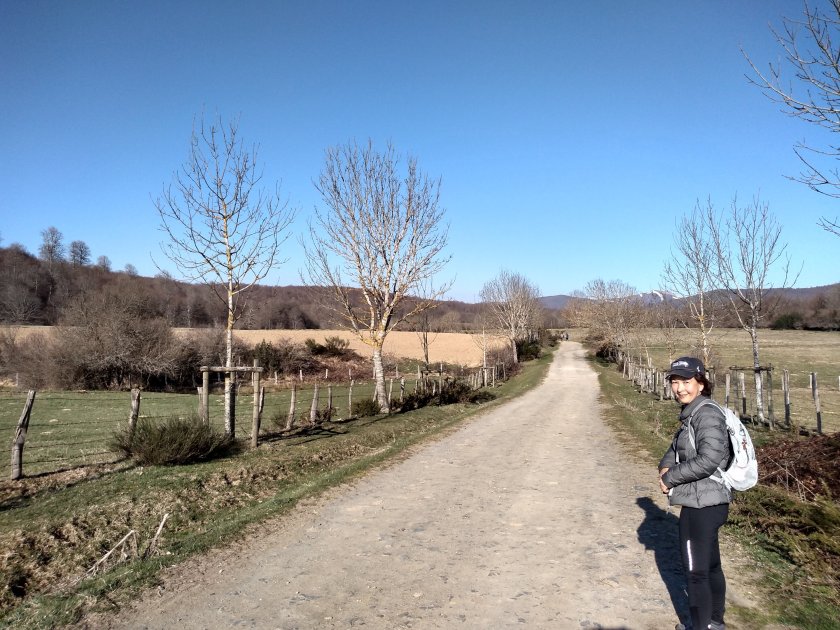
The trail out into the countryside
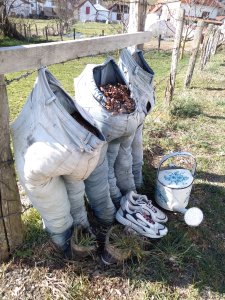
The Re-Use part of the 3Rs

A mobile shop. Makes sense for a store to come out to all the remote village residents, than the other way round.

The story to this picture. Note how sparse the tree branches are. How little green undergrowth there is. Yet, there were many birds chirping away.

Mother and colt were drinking from the water trough until I got too close!

We came across a herd of goats. Not a handful that we usually see grazing on a slope, but a whole herd. The shepherd must be somewhere!

They had horns!

Joon happily striding across.

We thought we would stop for lunch before reaching Zubiri to avoid the siesta hour. But the smaller villages before Zubiri are not set up for pilgrims. Once we checked into our Zubiri albergue, we thought it would be a good idea to have lunch. We let the other couple who checked in a few minutes later have use of the bathrooms, thinking it’s no big deal.

Our pilgrims lunch at the Cafe El Camino consisted of chicken pea soup, fish fillets with vegetables, water bottle and a surprising Nestle chocolate covered vanilla bar. Each was Euro 12. Great cafe.

We returned to the albergue to a massive crowd in the dormitory! Yikes! The loud chatter prompted me to quickly check to see if any double rooms were still available. Our luck was not in. We were the first to check into this albergue too.

That’s life, isn’t it? Sometimes, opportunities knock, and we think we have the time to respond. Sometimes, we don’t look far enough down the road. But holding the regrets is basically tearing the band aid from the wounds repeatedly. Perhaps this is a teachable moment for a bigger opportunity knock in the future.

So, the afternoon is carefree. To catch up on silent time. On reflection time. On journalling. On figuring the list of “Let-Go’s”.

We will have a simple meal tonight and turn in.

PostScript: As I needed access to power for my travel CPAP, we decided to choose two lower bunk beds. I swapped the lower bunk bed with Joon, as the pilgrim who was resting in her upper bunk bed in the afternoon, seems to dream a lot of action movies. That premonition was correct during the night. That gentleman has vivid dreams, where it’s not just turning over on his side, but violent arms and legs movements that shakes the bunk beds. I have the ability to get back to sleep almost immediately. In future, we will share one upper/lower bunk bed.

SJPP to Valcarlos

Mar 27. Day 1.

It looks like my body cannot sleep beyond 9 hours. Which is a good sign as I am not sleep deprived. But it does imply that if I go to bed early, I will wake up early. Poor Joon!

It has been two straight nights since we haven’t had ‘proper’ dinner portions. Guess what – there are no hunger pangs nor stomach rumblings. Our daily buffet breakfast and buffet dinner during the Holy Land Pilgrimage had probably built some reservoirs!!The Palestinian Christine family who hosted us one night in Bethlehem did share that their main meal of the day was lunch, when both husband and wife are able to turn home for the joint lunch. Dinner was a very simple affair of fruits and light snacks. This seems like a great practice. Let’s see.

We had brought a Lenten booklet that our Parish head distributed. The daily readings are helpful to frame a spiritual context to our Holy Land Pilgrimage and Camino Frances. We read this in the mornings.I took a look around the town from 6.30 am as I was interested in some morning photography. There was only a man waking his dog.
(All picture uploads have failed for now. So, placeholder names for now while I try to resolve).

The Golden Arches in SJPP

This bridge which we walk over to start our Camino was lighted up with colors, creating that purplish hue

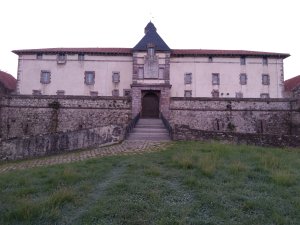
The Citadel was a French military garrision in the 16th century. Part of it is now used as a school.

View of SJPP

As the sun rose higher, the upper parts of mountains took in this coloration

We left SJPP just about 8am. The morning was cool, Joon had her down jacket and I, my down vest plus fleece sweater. The 11.4 km uphill today to Valcarlos took us 4 hours 20 mins, with morning stops accounting for 30 mins or so. The illness continues to plague us, especially when we are sleeping together and thus, perhaps creating contagious cycle between us. I felt much worse in the afternoon, when I showered and rested, experiencing some chills for the first time. Joon had chills some previous nights and her cough sounds bass-ominous.

The colored guide sheets from the Pilgrims Office was very helpful. It’s important to get this, so you know when the river is on the left or the right of your hiking paths. Was it a happenstance that the luggage transfer staff mentioned that I could get this, in addition said office being very near it?

I had downloaded maps.me app plus the local databases as this App works on GPS (i.e. you can use it even if you don’t have cellular or data service). This worked very well till a critical point.

TIP: Consider Maps.me but use with the brain engaged.

Leaving SJPP for Valcarlos was along some inner residential roads. Traffic was light. We came to a turn off, which took us past farms and pasture lands. It was refreshing to be back hiking surrounded by nature.

Within the first hour, it dawned on us that we may not come across any cafes. That turned out to be the case until just after the 2nd hour of our walking. Fortunately, we had some bars in our packs.

Idyllic countryside

We saw many farm animals, chickens, sheep, cows and horses. Even got close to a pig whose sty was by the trail. And this is the Year of the Pig!

We settled into a routine, the stages were not that steep. One could say, this day was getting our walking legs in/despite our current physical condition.

Eventually, we came across a built up area with supermarkets, cafe, etc. We stopped for a delayed breakfast. ‘Signs’ can come in all sizes and shapes. Using the Maps.me App, it suggested that we should start walking on the main roads, where big trucks and buses run. Our internal alarms went off, so we stop on the road after about 20-30 meters, to consult the hand out guide from the Pilgrims office. A old French gentleman came up (he was sitting in his motor home by the parking area), and through some French deduction, we figured there was a safer trail to take. The Camino signs were not as clear, and Maps.me totally mislead us. As we walked this trail that paralleled the busy road, we could see a couple of backpackers/pilgrims walking on the road. I trust they are safe but the experience will be daunting.

Near the end, there was a moment when we wondered how we were going to cross the River as we could see Valcarlos in front of us across the river, but the path seemed to going on this side of the river. The paper guide showed the way, but in our haste to get there, we mis-read the picture. Fortunately, that dead ended quickly, so we’re able to retrace and find the proper way.

Never did a bridge look good as this one. The right perspective can add a glow to any perceived circumstance.

We made our way to the designated restaurant, Benta Ardandegia, to have our lunch and pick up our bags, and a map plus a Pin Code to enter the municipal albergue. Despite a sign saying the albergue was closed from 0800 to 1200, the caretaker didn’t show up til late evening. Two pilgrims didn’t know the Pin Code, so, we let them in. They were fortunate we were there, due to our luggage transfer! Somehow, the Camino used us to help them!

This municipal albergue probably set the standard for alberques. There were only 4 of us in a 10 bed dorm. There was another wing of 14 beds, not opened yet. There were lockers. And they offered self serve breakfast, instant coffee or tea and wrapped mini muffins. We had bought yogurt.

The veal at lunch was not tender and tasted fairly bland (it could be my cold is a contributing factor). The dinner paella with chicken was much better at Bento Arkenza.

Since my condition was not improving, a trip to the pharmacy was made. It’s extremely difficult to use a CPAP machine with a stuffed nose and scratchy throat. The nasal decongestant worked and I slept for 10.5 hours!!

Thus, our day ended. It’s going to be a war of attrition with the cough and cold besetting us. But we have this figured out.

PostScript: The Napoleon route over the Pyrenees officially opens on April 1, but due to the mild winter, quite a number of pilgrims are taking that.

Valcarlos to Roncesvalle**

Mar 28 Day 2. 11.4 km. Elevation gain.

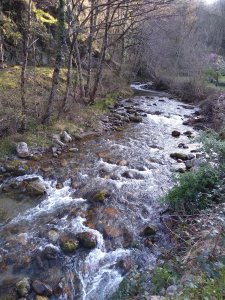
The caretaker had come early in the morning and left the self serve breakfast. We left our Euro 20 on the table with our registration forms as we never got the opportunity to meet her/him. A great business set up and labor utilization, when human nature can be trusted, as on the Camino.The route out of town followed the main roads until about 20-30 mins my when a side road/trail to the left appears. This led us to a trail by the river, through valleys. It was very tranquil. The route was such that once we veered away from the main roads, we could no longer hear any traffic noise. This is a section where you do not want to rush through.For a larger part, we were either just above the river or near it.There’s a tangible therapeutic effect of the river’s rushing. The intangible is the positive ion charged air in the vicinity. Birds love it too as they are merrily chirping away.The water is very clear. Due to the rocky bedrock, one can see a cascade of micro-falls, akin to a string of pearls.At one stage, the river cascading down crossed our paths. Thus, we had a stereo-like experience, hearing the river’s serenade with our right and left ears at the right points. Quite amazing.Babbling brooks are real too! Their gurgling sounds are soft on the senses.

One part of gushing river

I was struck by the green vegetation on both sides of this river

Joon had an interesting experience with her uphill and down hill walks. Her left knee troubled her on the former but her right knee was the culprit on the latter.

All of us who had observed Tai Chi practitioners are appreciative of the grace that underpins the movements. I had applied a part of my Tai Chi learnings to my uphill walk. In Tai Chi, the forward leg touches the ground as heel – ball of foot – toe. Doing this intentionally, while slowly breathing in and out, allows one to utilize the slope for contemplative movement! The mind is no longer occupied with thinking when one will reach the top/summit point, but I’d enjoying the graceful change in weight transfer and forward movement.

We arrived at Roncesvalles at 1pm. Our room at the Hotel Roncesvalles was very nice for Euro 67. There was no restaurant open, so we resorted to our back up provisions. We dined later in the hotel restaurant at 7pm on their Pilgrims Menu – potato soup, pan fried trout and red wine. The fish was very good, crispy skin, tasty flesh. All that was left on my plate was the fish skeleton. And they did not put fries, but baked slices of potatoes!We then proceeded for the 8 pm Mass at the Church of Santa Maria. A beautiful Church. We had the Eucharist, and the oldest. Pastor called all of us pilgrims to the front, for the Pilgrims blessing. He said that in about 10 languages, including Korean! I know understand why there was a form seeking our nationality and reasons for the Camino when we sought the passport stamp (sello).

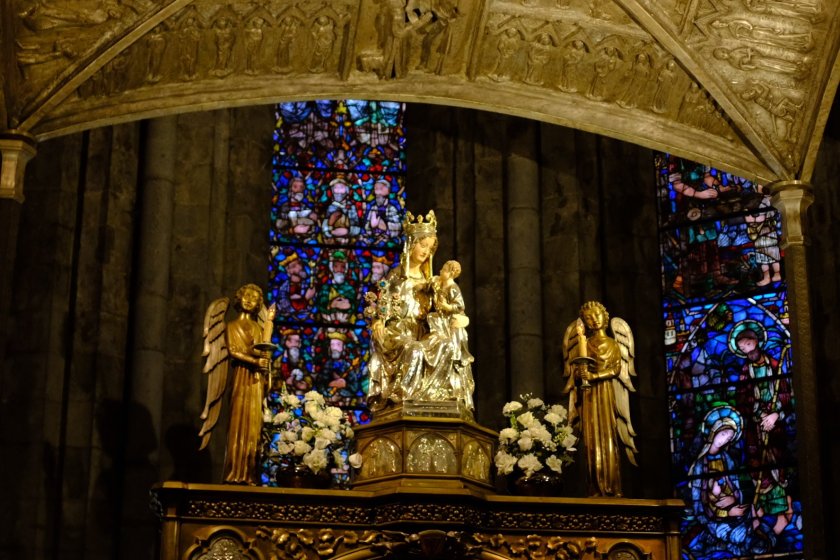
The main altar of the Real Colegiata, Roncesvalles

Close up of the Virgin of Roncesvalles, a wood statue brought in the 13th century from Toulouse. It was officially crowned as Navarra’s patroness in 1960. The 1945 silver baldachin canopy is an exact copy of the baldachin in the Cathedral of Gerona.

Rose window over entrance

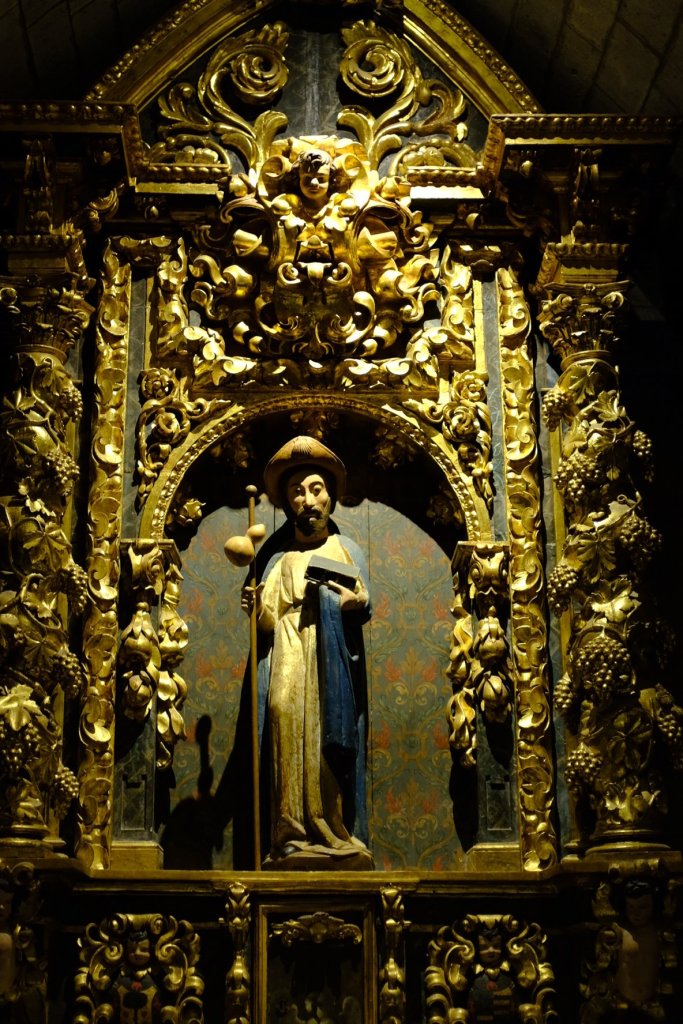
Side chapel of St James

Joon by a picturesque part of the river.

Off to bed, recharged by the pilgrims blessing in the battle against cough and cold.It was a wonderful day.PostScript: A thrown away small pate type can triggered me to pick up trash after that. It seems an appropriate way to give back to the Camino.

PostScript: Am using a 3 Star for various sections. This day was a 2 Star (3 Star calibration is the Meseta section).

Travel to St Jean Pied de Port

Mar 26. Day 0.

Our bus from Pamplona to SJPP leaves at 1430 hours. Prior to falling sick, I had thought the free morning would have been a great opportunity to see Pamplona’s sights. Our hotel is located in the historical quarter which is very central.

Our respective health did not seem to improve over night. My cold has worsened and Joon’s cough is stubbornly holding on with multiple greeny hands.

My sleep last night was the most interrupted since I flew out from Seattle.

It struck me that this illness is perhaps a way for us to empathize with those who begin their Camino in less than optimal health. I had been reading and praying about ‘humility’ as we travelled (having the right e-books on the Kindle has been a boon to me). Could this be a response to my prayers?

We took a leisurely walk outside from 9-11am. It was 10C/50F. Definitely needed my fleece sweater.

Pamplona was founded by Roman general Pompey in 75 BC! This is seriously old.

Our first stop was City Council, as its facade is world-famous Baroque. Would you agree?

Pamplona’s City Hall

Several blocks away was the Cathedral of Santa Maria la Real. A Spanish Mass service was just beginning. It was lovely hearing the chanting as we decided to pray the Divine Mercy chaplet in the Divine Mercy chapel.

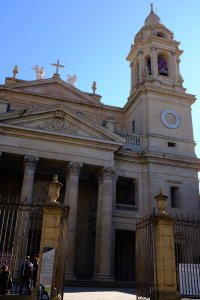
Facade of the Cathedral. This tower has a large bell, 12 tons.

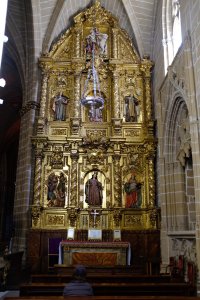
Interesting main altar with its iron gates

Divine Mercy chapel

As we walked these old streets, there are interesting facades and shops.

Someone taking pictures of this facade caught my attention.

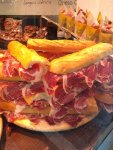
Mouth watering jamon ham sandwiches

These were priced at Euro 3.95. Packaged for eating on the go, no?

Fishy display!! Love it

Close up of the fishes in the display window fronting the street.

We returned to the hostel and relaxed before checking out at 12pm. This Hostal Arriazu is highly recommended – black out curtains, comfortable beds, quiet, modern bathroom, self serve and locking luggage cabinets if you need to leave them behind for a while, a great map of the area, coffee machine (1 Euro), microwave (latter two in reception lobby). Euro 44 for the night.

We decided to take a slow walk, restaurants only open for lunch at 1pm. The bus station was underground with shops and a cafeteria. Latter is passable, one of those diners along American freeways that is a forgettable experience.

A number of backpackers started coming into the cafeteria at 2pm. This bus is un-numbered (i.e. no designated seats on the tickets). Hopefully, it’s not full. The bus had about 11 passengers, and about 8 of us dis-embarked at SJPP. The ride was only 2 hours, but a long two hours via mountain roads, with many twists and turns. The bus did lurched from side to side many times.

Our bus driver went up to the front of the bus prior to driving off, speaking in Spanish and holding a blue plastic bag. I told Joon it was probably about discarding trash. Half way through, we figured it was barf bags, which Joon unfortunately had to use.

TIP: If you are the type who takes Dramamine when traveling, do skip lunch prior to boarding this 1430 hours bus.

Our routine on the Camino is quite straightforward. Once we check in, it’s unpacking the essentials and doing a quick hand wash of our clothes.

Joon rested while I strolled about SJPP. Went up some walled walkways, stopped in a church and a grocery store (for some fresh oranges). The storekeeper’s ‘Au voir and Merci’ reminded me that I was now in France. I was still using my limited Spanish of ‘gracias’. This also explains the fashion stores I saw during my walk about.

During my walk, I realised our accommodation didn’t have a staffed reception area (they had previously provided instructions on how to get my room key from a locked box). Net, I contacted them to inquire about luggage transfer. Fortunately, someone responded in French (the staff who speaks/writes English had probably left) and I could guess the core essence of the message. I then called the luggage transfer services and was able to arrange this before they closed at 7pm. The Pilgrims Office was several doors away, so we got the extra credential/passport that we needed (one in Spanish because I had ordered a book, the other in French). We got some additional info, they close at 8pm.

TIP: If you are planning to use luggage transfer services, arrange it while offices are open. Express Bourricot handles luggage transfer from SJPP up to Roncesvalles, after which Jacobtrans takes over. E/B can be reached at +33 661 960 476.

E/B mentioned that they had 60 customers today. During the peak season (May thereabouts), they can average 500 a day!

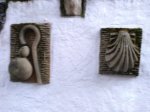
Symbols of St James the Pilgrims

Evening view across the streets of SJPP

Joon preferred not to eat dinner, fortunately I had bought some oranges during my walk about , and I had a protein bar.

We will be waking up tomorrow to the morning sun as our room lacks any curtains or shutters. An unexpected experience to relish.

Our Camino Frances begins tomorrow!

Post script: I brought and used a soap bought when we visited the Dead Sea. A way to connect these two pilgrimages!

Travel to Madrid and Pamplona

Mar 25. Day -1.

We flew into MAD(rid) via Gatwick, London. Latter was our hub for our Holy Land pilgrimage and Camino Frances.

LGW – MAD is a 2 hours flight. When we touch down in MAD at 1335 hours, we have 1.5 hours to catch the train to Pamplona. We will overnight there before catching a bus the next morning to St Jean Pied de Port (SJPP) It would have been too taxing to attempt to get to SJPP all in one day. That’s why this is Day -1.

TIP from my niece in London: Turn off the air vents above one’s airplane seats so that one doesn’t catch any virus circulating through the air ducts.

Our streak of not catching anything on air travel ended with our return from Tel Aviv 3 days ago. A passenger on the TLV-LTN flight in front of us was coughing, and we both caught it. Joon had it worse. Hopefully, we will recover fast and fortunately, the first two days walk from SJPP is half of the usual distances that we typically walk.

Our backpacks are packed to the maximum. We left several items in London as temperatures are higher than expected (e.g. gloves). We also bought several items at the Decathelon store in London (e.g. men’s rain pants for less than Pounds 9). But given it’s a longer Camino than our CP, and that we are using more albergues, we brought some new items, such as liners for sleeping bags, day packs, Kindle and iPad Mini. The liners and our backpacks were treated with Permithin. My backpack weighed 20 pounds, Joon’s 16 pounds. As mentioned previously, we will utilize the luggage transfer services to ferry our backpacks to the next town/village. The max packed bags limits what we can buy unless we wish to ship something back to London. Our Parish Priest had commented during the Holy Land pilgrimage, that he was trying to get us to transform from Consumers into Disciples! We didn’t buy much on the CP, so, this should be fairly easy for us.

The plane left 35 mins later than scheduled as we waited on the tarmac for a slot. The pilot made up time and it appears our arrival in Madrid will be about 6 mins later than scheduled. The de-plane-ing, being bused to the terminal and immigration control left us an hour to get to the train station. Taking the bus which comes every 15 mins and makes stops would be impractical. Taking a taxi was the best option. Along the way, we came across an accident that probably occurred minutes before we reach the spot. Two ambulances drew alongside our taxi as we changed lanes. Divine Providence that we were not further behind and faced getting stuck in a massive traffic jam.

One of the scourges and risks in traveling is coming across unscruplous vendors who prey on tourists. We met our first one in our taxi driver. The information desk staff had informed us the taxi ride from airport to the train station was a fixed rate of Euro 30, which was collaborated by the taxi meter reading. Our driver said the fare was Euro 42 due to supplemental charges. When I objected, he switched to Spanish and raised his voice, a tactic that most recognize as a way to intimidate one (they speak acceptable English when they first try to secure your services). Perhaps to avoid being a helpless victim and prevent such unscruplous people from preying on others with impunity, one should find out a Complaint Helpline and take a picture of the situation. Oops…. searched the Internet on the train and one needs a receipt with the relevant details. No wonder our taxi driver was in a hurry to get out bags and depart the crime scene. Whatever you decide, keep your inner calm. It’s only money and perhaps one less meal.

TIP: Ask for a receipt with details of the particular driver/vehicle. Consider pulling out your smartphone and start video taping these unscrupulous taxi drivers and their ilk. They might just back off.

Figuring out the train platforms in Madrid (upper and lower) required one to note minor details, such as the two platform names on the sign board. Not being tunnel focused on just the Platform Number. Some other passengers were traveling on the same train, and we were advised by a train staff who was traveling to follow these other passengers.

I missed taking a photograph of the central train station as I wanted to get to the platform asap (had 30 mins to spare). It had a lush green in the center, with trees, bushes, etc. A reminder from the Camino to start slowing down.

The Renfe train is smooth and relatively quiet. TIP – bring your own headphones with standard jacks to take advantage of the video (or music). You could improve your Spanish during the train ride.

Fortunately, I decided to book the train tickets while I was in London over the weekend. The good seats (facing forward) were all taken up (there was a handful of two front facing seats available when I had booked).

Train seat cushions were thicker and better than on our EasyJet flight to Tel Aviv

We arrived as scheduled at 6.26pm. As it was chilly and both of us were under the weather, we opted for a taxi. This driver was great, taking some inner roads and dropping us at the closest point to the hostel (latter was located in a pedestrian only area). Euro 6.50.

Restaurants in Spain only offer their dinner menu from 8pm. Given our preference to rest/sleep early after a flight and train ride, we opted for a simple meal (tortang patatas with ham) plus hot chocolate.

The beds called to us at 8.40pm.

Ein Karim

Day 11. Our last day with the group as our departure flight differs from group and we won’t join them for the tour’s final half day program.

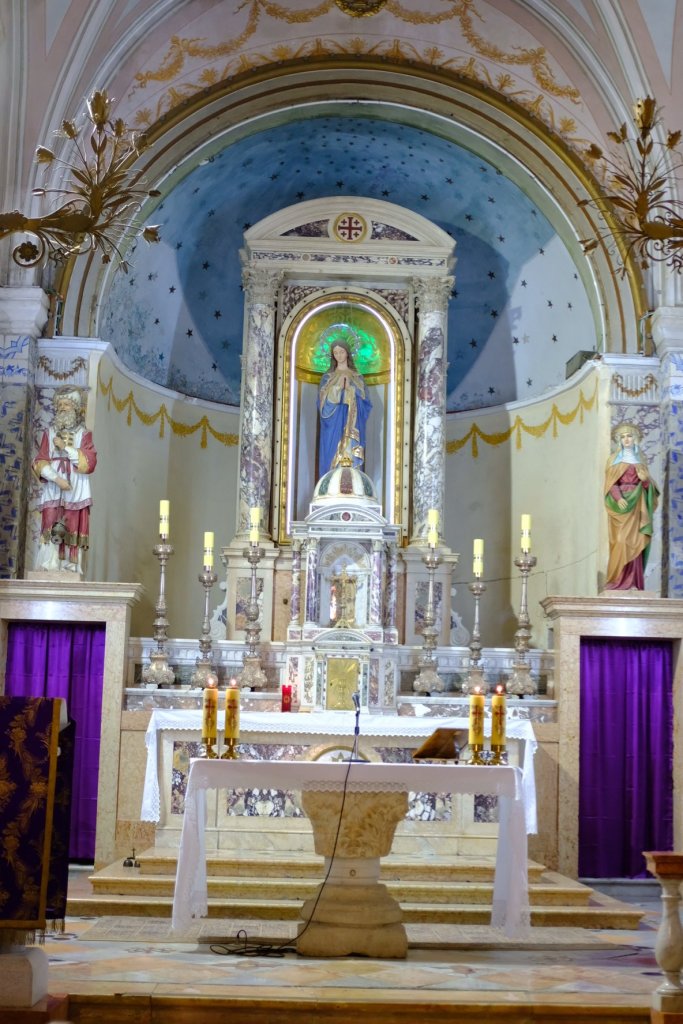
Given our Parish in USA is St John the Baptist, it was expected that we would visit such in Jerusalem.

The altar in the Church.

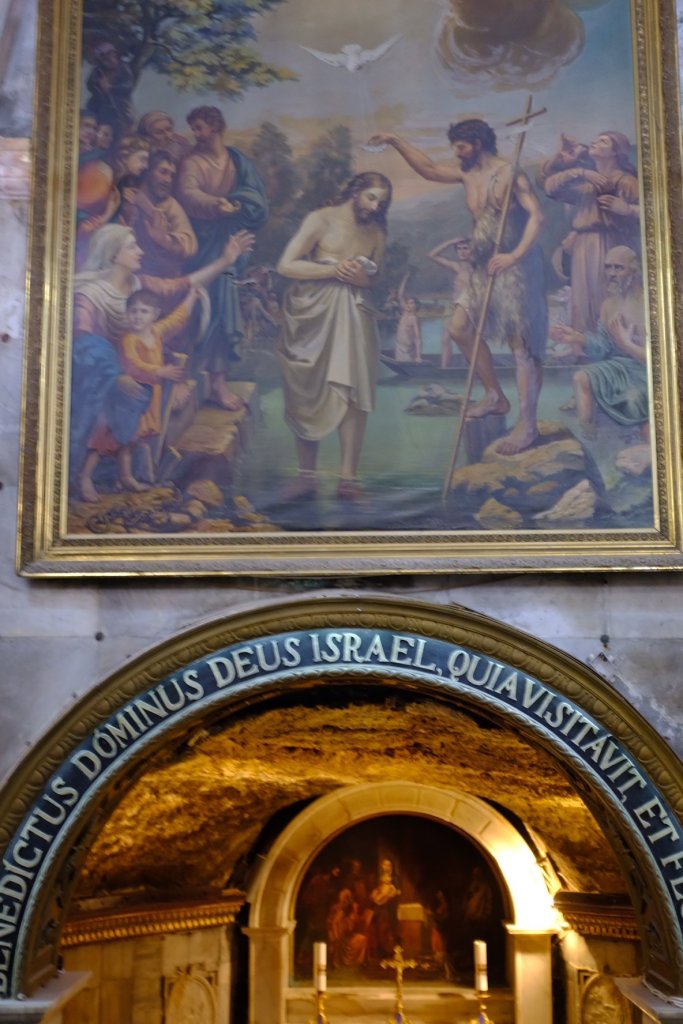
A key event in John the Baptist’s evangelical mission, the baptism of Jesus. Below is a small enclave, that is dedicated to John the Baptist.

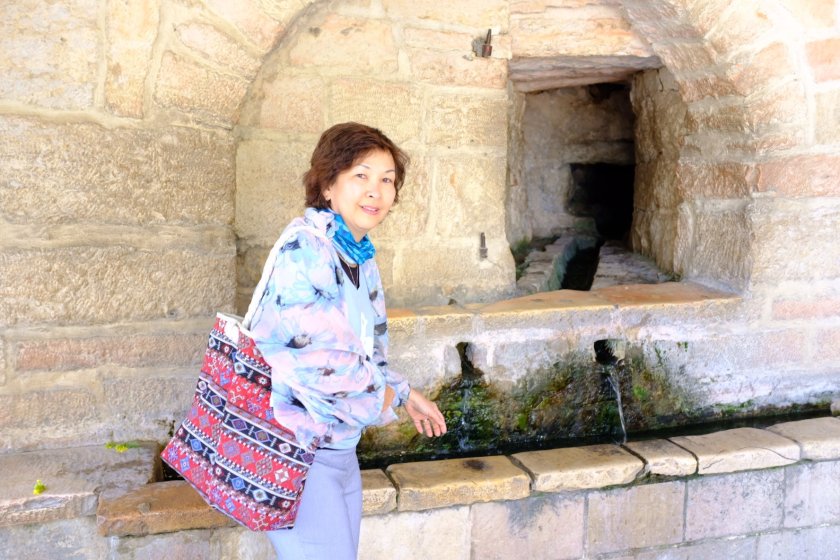
On the way to the Visitation Church, we came across Mary’s spring. The water is no longer drinkable.

The Visitation Church is Antonio Barluzzi’s last church. It commemorates the visit of the Virgin Mary with her cousin, Elizabeth who is 6 months pregnant with John the Baptist.

Facade of the Visitation Church

Close up of Mary going to visit Elizabeth

The lower level chapel had murals telling the story of Elizabeth and her son’s escape from King Herod’s soldiers.

Lower chapel mural.

The upper and main chapel was bigger and we were fortunate to be able to celebrate our Mass there.

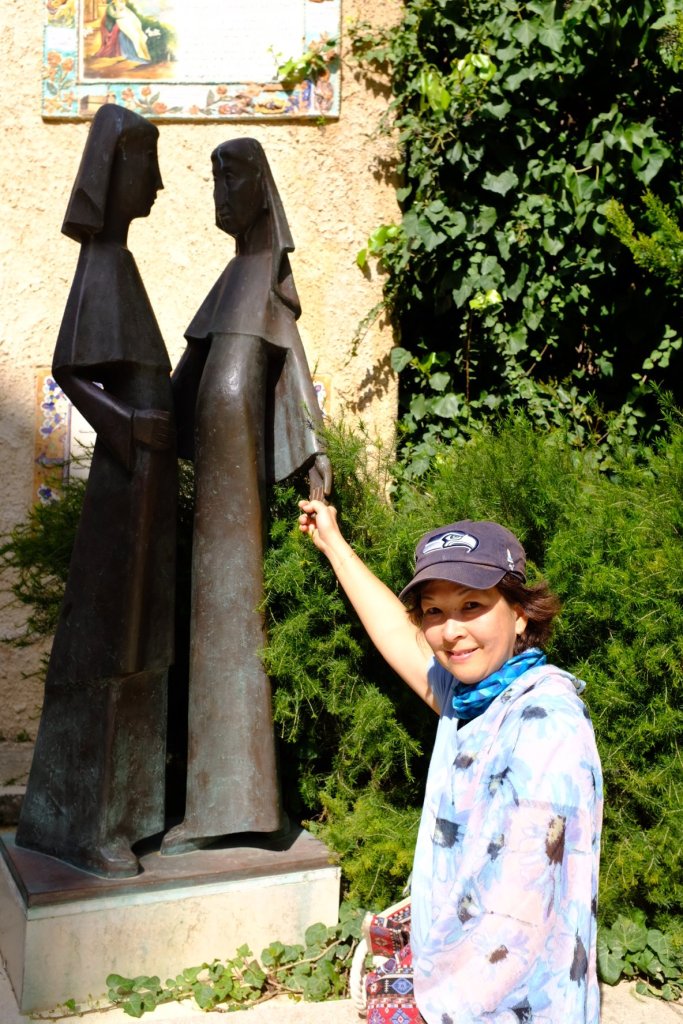
Sculpture of Mary and Elizabeth. Latter was much further along in her pregnancy.

How often do we find those who are of greater stature making the first gesture and humbling themselves? Where hurt had been created between us and someone else, it’s the first move to reconcile determined by who was more in the wrong?

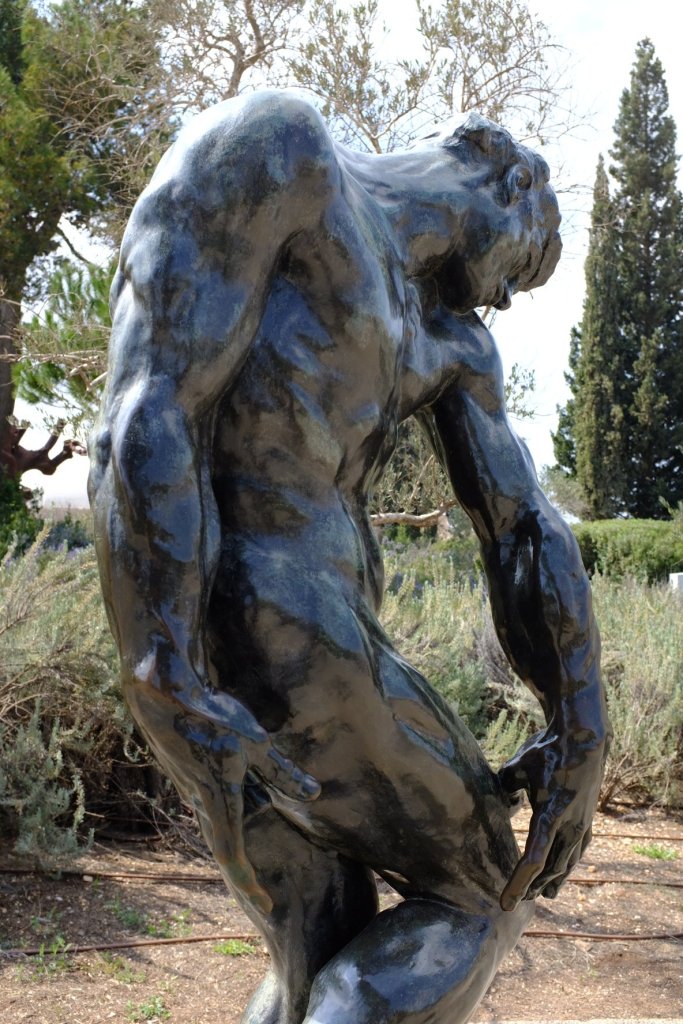
Our next stop had this sculpture in the courtyard. Can you guess where this was placed?

A famous French sculpturer, Rodin.

Here’s another picture clue.

Definitely man made. Of iron. By Chinese artist Ai Weiwei.

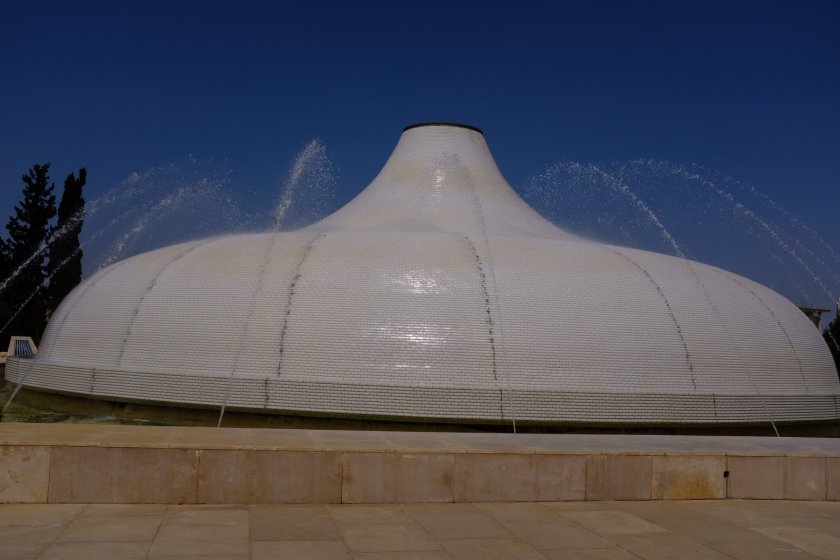
Yup, we visited the Israeli museum where the Dead Sea scrolls are kept. The building is symbolic of the jar lid. It’s also painted white to represent the Essenes as Sons of Light. A black wall facing this represents Sons of Darkness, as the Essenes considered the Jews in Jerusalem as having comprised their lifestyles from the strict codes and laws.

Shrine of the Book, housing the Dead Sea Scrolls

We ended the day with an (unexpected) dinner hosted by Holy Land Tours. They had arranged a local dance performance by high school kids. Very energetic. Wow, what a fabulous end to our tour program. And generous gestures from our tour organizer

Dead Sea

Day 10. It took us an hour plus to travel from Bethlehem hotel to the Church of the Good Shepherd, Jericho (we had visited 3 days ago). We had an outdoor Mass this time at this church. Joon was asked by Father Jim to help with the communion wine.

Outdoor morning Mass in Jericho, Joon assisting with the Eucharist

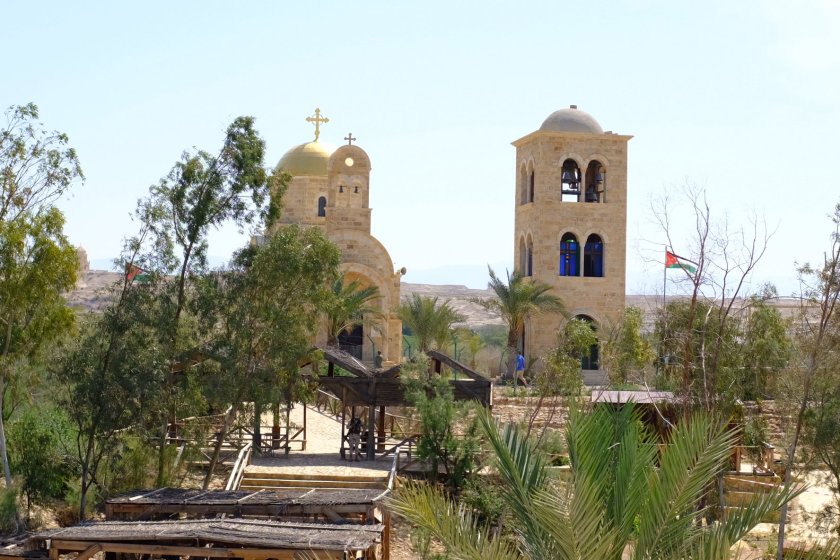
We headed to Jesus’ baptism site on the River Jordan. The River marks the border between Israel and Jordan. Across the river, we could see a number of churches. The King of Jordan had offered each Christian denomination free land to build their church. Such a generous gesture in a land of conflicts!

Churches across River Jordan, Jordanian flag flying

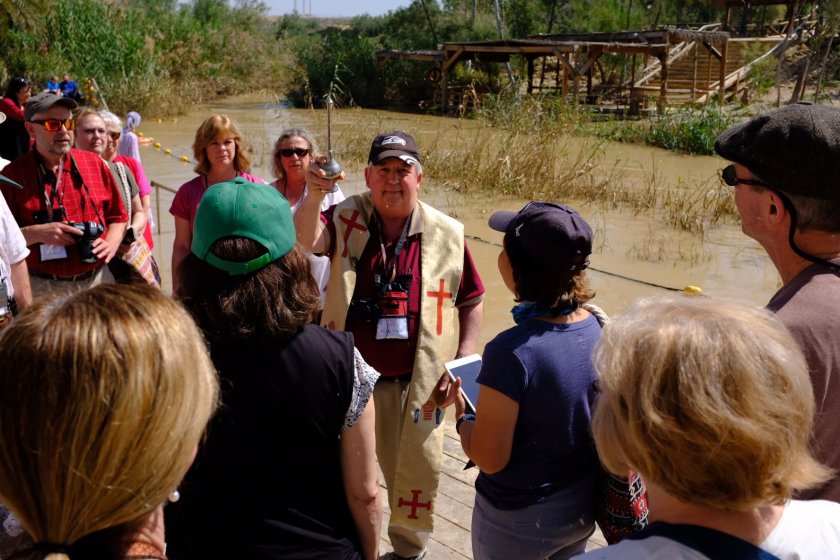
Here is another benefit in going to the Holy Land with one’s parish. Father Jim conducted a baptismal renewal rite for us at the banks of the River Jordan! Truly a great way to commemorate our visit to this location.

Father Jim blessing the group as part of the baptism renewal rites at the River Jordan

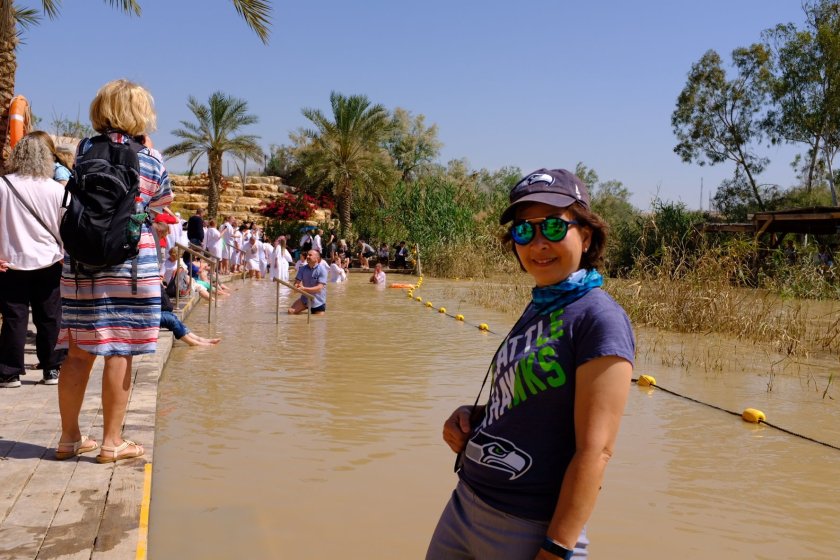
Baptismal site at River Jordan

Heading our way to the old quarters of Jericho, the lowest and oldest city in the world. Tell es Sultan is the excavation site where they found ancient ruins dating back to 2700 BC!

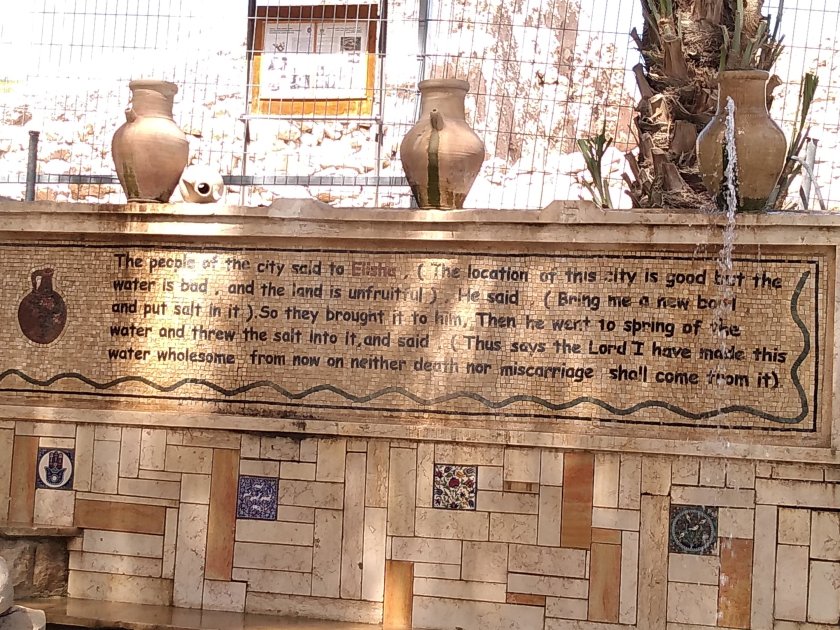
Note sign board.

The springs from mountain melt flowing into Jericho

Opposite this site is Mt. Temptation. The local name means 40, alluding to the 40 days of temptation faced by Jesus.

Can one succumb to temptations without realizing it? And what if one believes there’s no temptations at all, but just experiences and desires?

After lunch and a shopping stop, we headed to Qumran. 900 over manuscripts written between 200 BC to 60 AD by the Essenes. Written mainly in Hebrew, a small number in Aramic and Greek. It’s worth viewing the 7 min presentation but ensure the admission staff schedules your group in line with your wait time and language.

The walk through the site is not to the caves where the scrolls were found but through the site where the Essenes lived. It was interesting to see how they built water channels to slowly capture sediment and leave fresh water.

Cave 4 where some scrolls were found. Entrance to cave was level ground, namely the Essenes walked into the cave before erosion occurred.

Camel rides and picture taking offered at various locations. Typically for USD 5.

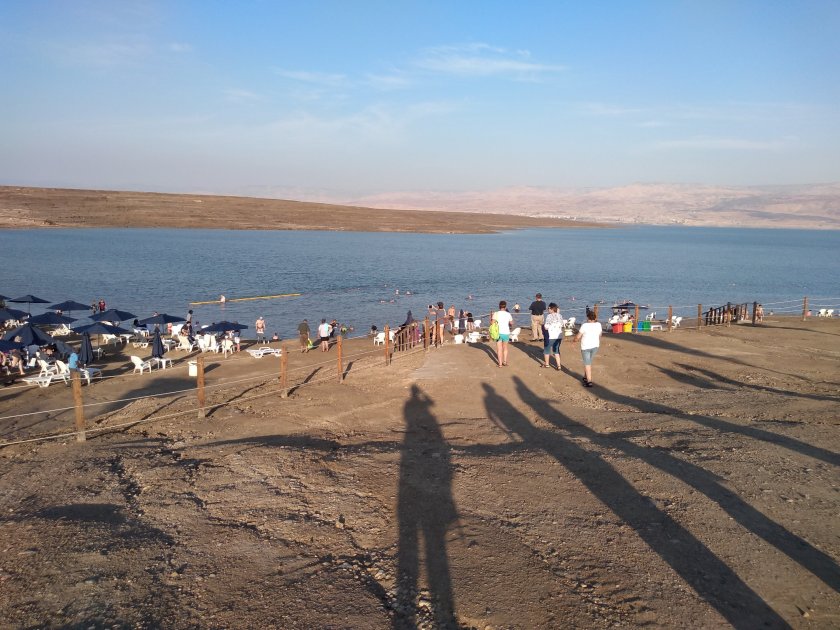
We reached the Dead Sea about 4.20pm. George highlighted certain precautions about going into the Dead Sea due to its high salinity, which was reinforced by sign boards. Net, even a drop in one’s eyes can be painful. If you have an open sore, be careful.

I brought my goggles which help but still some sea water got to my eyes. Definitely painful. The taste is not just very salty but there was a mineral taste to it. Floating is very easy, and it’s quite difficult to swim normally as one’s legs tend to stay above water if one is using one’s arms!!

It’s difficult to stay long in the sea as the sea water does seem to penetrate one’s skin. Interestingly after changing, I could feel some salt crystals inside my ear.

One could collect one’s own mud if one had brought some containers. Lots of shopping and eating options at the beach.

A longish day was capped by a dinner hosted by Holy Land Tours with dances by high school kids.

Jerusalem Redux

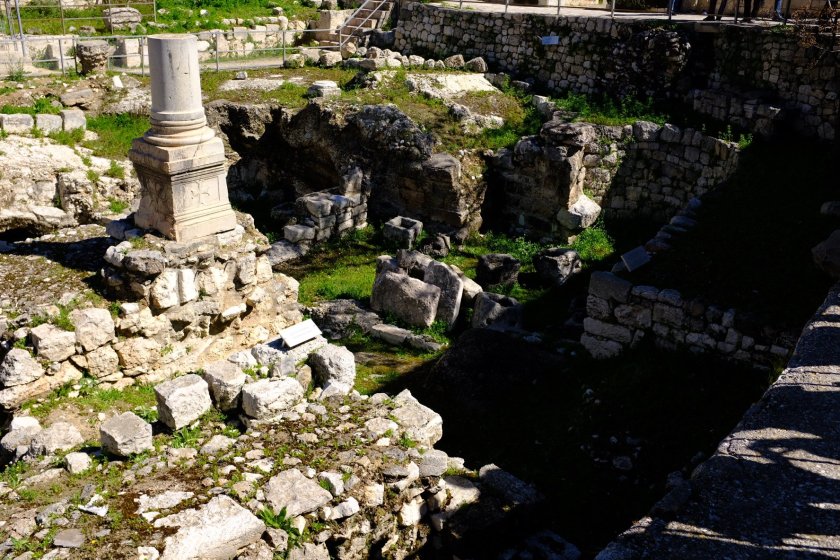
Day 9. Bethesda Pools was one of three locations in Jerusalem where Jesus performed miracles (a lame person sitting by the polls was healed). The Jews believed the first person in the pools for the day was definitely healed, so, there was typically a rush when it opens (according to our guide, some even climb over the gates before opening hours you beat the rush). Is there a non-religious or non-spiritual equivalent in this modern times? Yes, as we have psychiatrists, counsellors, doctors, etc. Can we in our own ways be channels of healing for those around us, in our work and occupations, during our rest and play, during our social interactions, during our parenting, etc?

Remnants of the Bethesda Pools, with a few remaining columns of the 5

Next to the Pools is a church built by the Crusaders, one of two still standing in Jerusalem. This is the Church of St Anne.

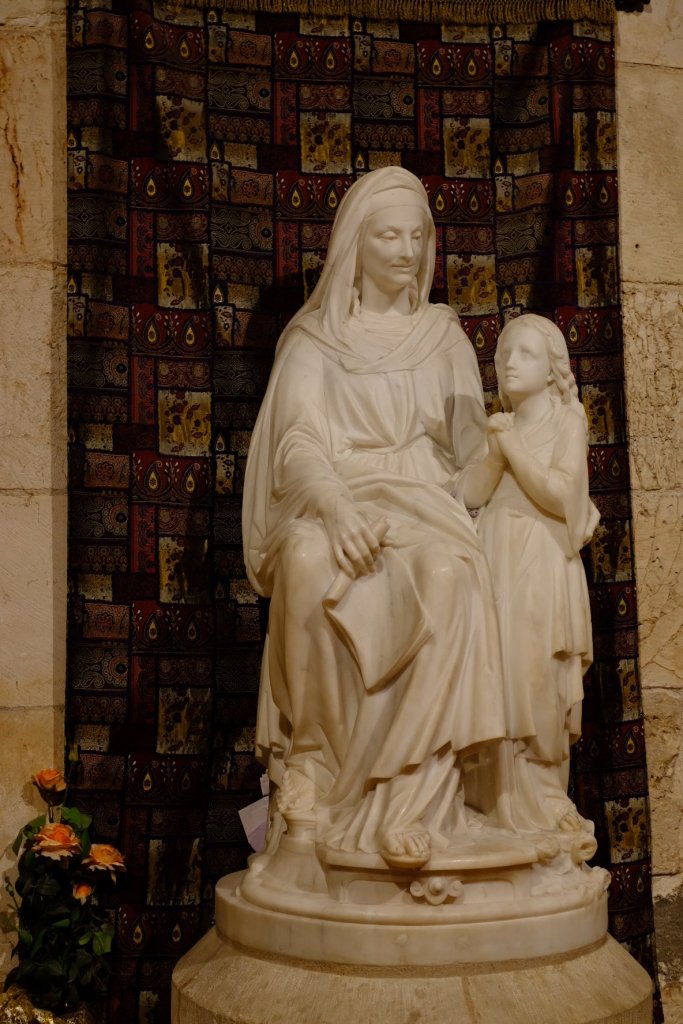
St Anne was the mother of the Virgin Mary. There is minimal decorations in this church. However, the acoustics is amazing. Singing in the middle of the Church nave amplifies the sounds throughout the Church. Our group and others same various Christian hymns.

Church of St Anne

Sculpture of St Anne and Mary as a child.

We then proceeded along the Via Dolorosa, following the Stations of the Cross, which traces Jesus torture, sentencing, carrying of the Cross, crucifixion, death and burial. The later stations are in the Church of Sepulcher.

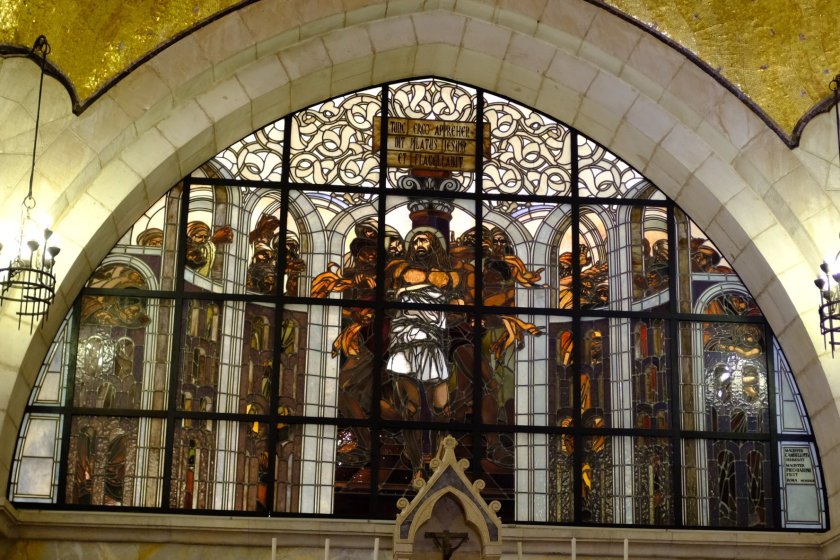
First station, a stained window depicting Jesus being sentenced.

Pontious Pilate washing his hands.

The ceiling’s mural is a crown of thorns.

The Via Dorosa is chock full of shops on both sides, catering mainly to tourists. There was the scattering shops that obviously cater to the locals. It can be quite over-whelming.

Each of the various quarters, Muslim, Jewish and Christian, have its own character and ambience.

Our last visit for the day was St Peter Church in Gallucantu (in Latin, it means cock-crow). This church was built over the house/palace of Caiaphas, the High Priest who presided over the Sanhedrin.

This was also where Jesus was imprisoned before being handed over to the Romans. We had a moving prayer and singing session at the dungeon level.

Atypical mural above an altar – Jesus with hands tied.

A wall mural

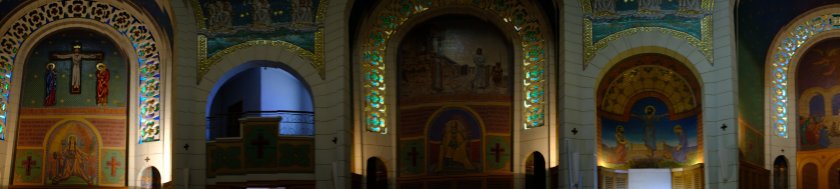
Above is a 180 degrees panaromic picture of the main chapel

Illustrative of how the walls in dungeons have holes through which ropes are passed through to bind prisoners

The actual road that Jesus took to walk into Jerusalem

Peter’s denial of Jesus three times shows how fallible human nature is. Yet, that mis-step did not deter Peter from fulfilling his mission, to build the Church body that Jesus assigned to him. Perhaps that’s the most important message from today.

Jerusalem

Day 8. There are many great cities around the world that residents and visitors will attest to. And there’s Jerusalem. A city above all else, that billions of people from three religions revere. Where history shaped lives for millennia. It’s intoxicating to imagine what was, what is and what will be.

We started the day with a visit to a Catholic School that takes in children with challenging backgrounds and will not do well in normal public schools. We had known about this prior to departing USA, and many of us had bought multivitamins and school supplies to give to them. Each child at different age levels are given an individual learning plan. They typically spend three years with two years of follow up to ensure they are able to adjust to normal school life or vocational opportunities. They can help more with greater financial support. Giving does enlarge one’s life.

Next was a visit to the Chapel of the Ascension, on the Mount of Olives. This is where Jesus ascended to heaven. It was an enclosed space with openings to let light in. One of Jesus’ footprints is in the floor in this chapel. The other footprint is in the Al Aqsa mosque.

Chapel of the Ascension

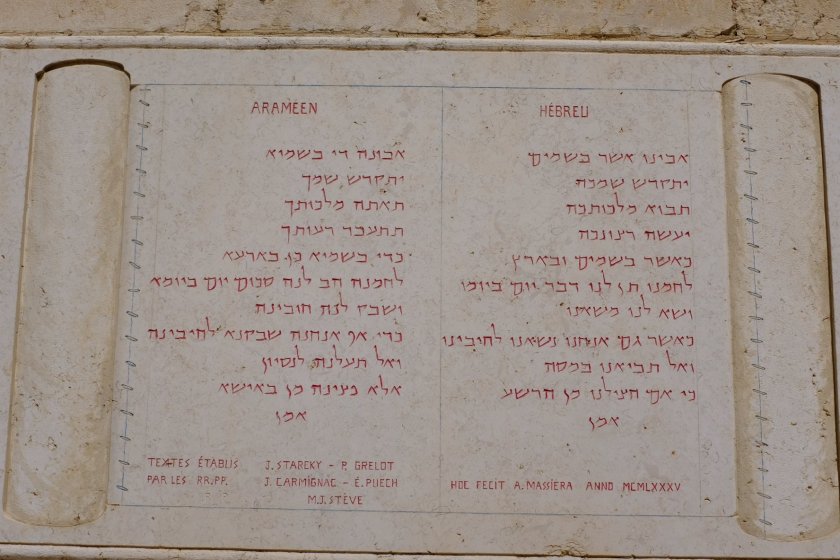
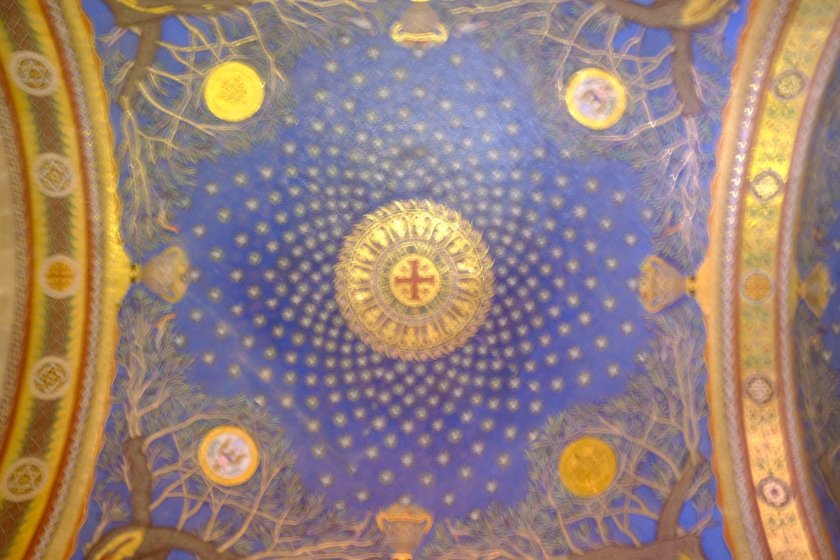
We then walked to the Church of Pater Noster, where underneath is a cave where Jesus taught his disciples the Lord’s Prayer. An Italian princess Aureli Bossi, completed the Church in 1847. It now has 185 translations of the Lord’s Prayer, the Our Father.

The Lord’s Prayer in Aramic and Hebrew

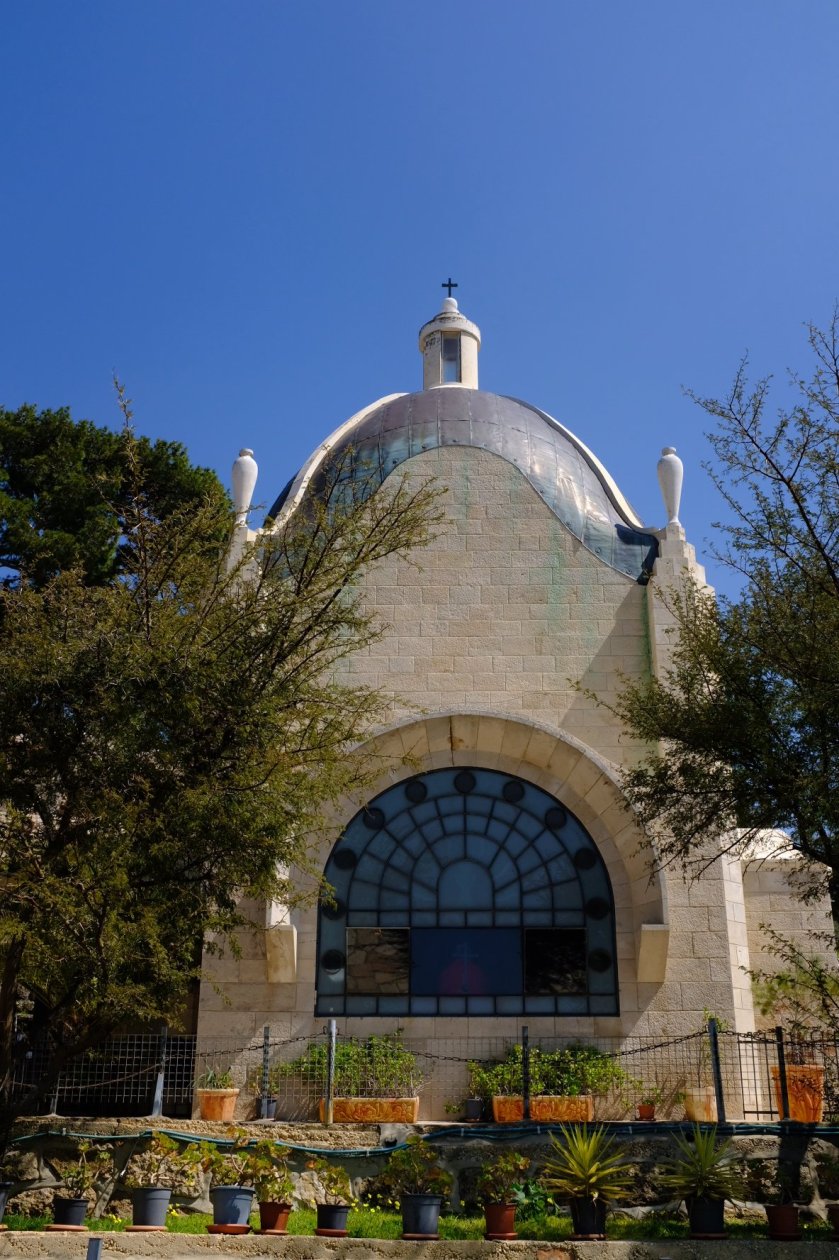
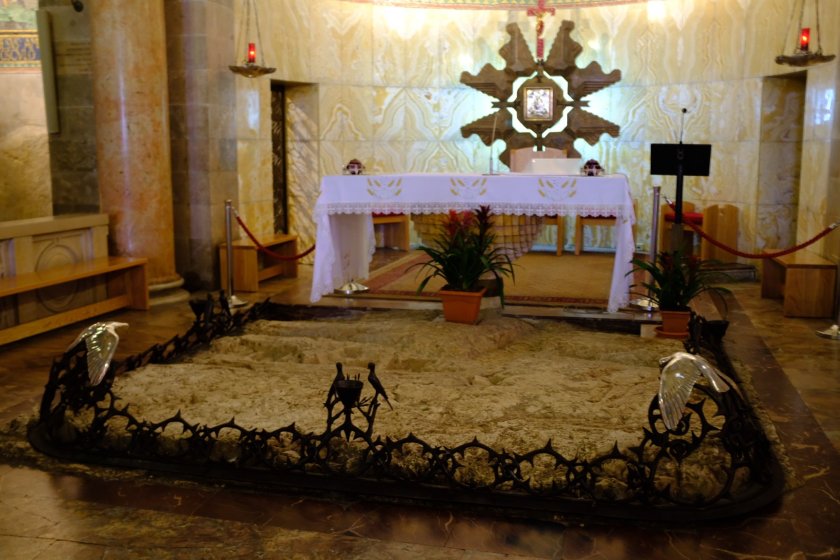
It was a downhill walk to the Dominus Flevit (Church of Tears) where Jesus wept for Jerusalem. It was designed by the same architect, Antonio B. This church was closed. The altar windows faces Jerusalem.

Corners represent tears and four corners of the Earth

We proceeded to a viewing point on Mount Olive, with spectacular views of Jerusalem. Our guide George then provided a masterful commentary of Jesus last days, tracing his journey into Jerusalem and all the key locations in the vista in front of us. As George was a Catholic himself, he could appropriately refer to the scriptures and add the local Jerusalem teachings. History came alive in front of us!

Dome of the Rock, Jerusalem

There are Jewish and Muslim cemeteries in the Kidron Valley and just off the walls. For the Hebrews, they believe the bodies in this Jewish cemetery will be the first to resurrect, highlighting its primacy.

Our next stop was the Garden of Getsemane, where a small rectangular plot of olive trees are maintained.

Garden plot is approx 1200 square meters in size

Next to it is a very beautiful Church of the Agony (aka Church of All Nations, as ceiling murals have various countries recognized). This church is also designed by Antonio Barluzzi, aka Architect of the Holy Land. At the altar base is the Rock of Agony where Christ prayed at.

The altar

Mural above the altar

The entire ceiling is decorated like wise with different country symbols.

One of the stained glass windows

Other visits included The Last Supper Room and King David’s Tomb, both in the same complex.

Most sites we have visited so far are managed by a Christian organisation. These two sites are managed by the Israeli Ministry. Thus, the (not original) Last Supper Room had also been used for Islamic purposes, and this had some Islamic inscriptions and stained windows. There only Christian symbol allowed in this room is a metal Olive tree, the branches and shoots representing the ok from shoots from Jesse. The grapes represent the wine/blood and the wheat at the base of tree, represents the bread/body.

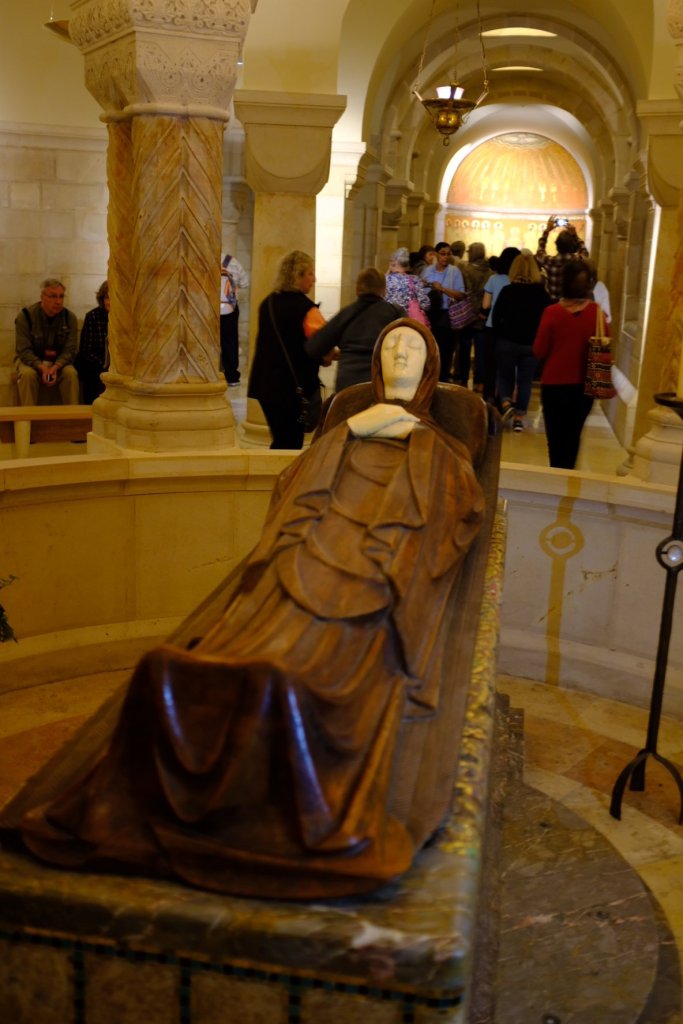
Next stop was the Dormition Abbey. The Abbey was where Mother Mary was taken up directly to heaven three days after she passed away.

A sculpture of a sleeping Mother Mary

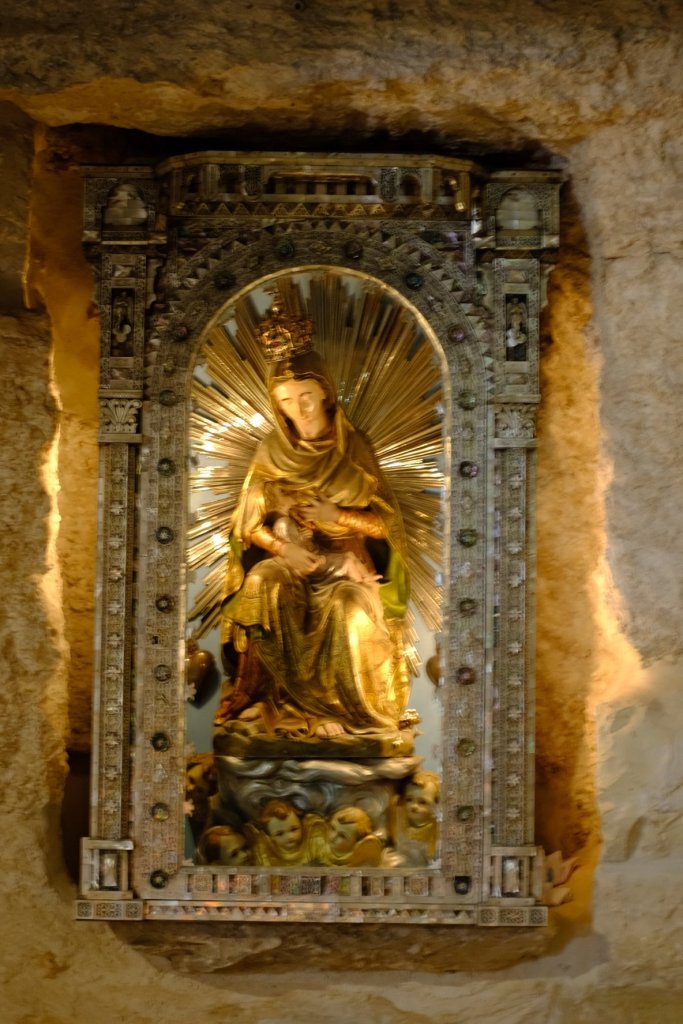
Black Madonna and baby Jesus mural in the Abbey

Our final visit today was the Holy Sepulcher where we celebrated Mass at one of the chapels inside the Church. An unforgettable experience.

Chapel inside the Church of the Sepulcher where we celebrated celebrated Mass

After which, we lined up to view Christ’s empty tomb. Both empty tombs viewed today represent the beliefs and promises that Catholics believe in.

Milk Grotto, Masada

Day 7. Miracles have taken place here in modern times in the Milk Grotto. Latter is so named as Mother Mary nursed baby Jesus in the grotto. Some milk fell on the ground and turned the grotto walls white. Powder is extracted and it’s that powder when taken, say with prepared foods, that provide the healing associated with this site. People with fertility issues have been able to bear children, including our tour guide’s wife who had two miscarriages. Testimonials of other healing are mounted on the wall in the shop in this complex.

Sculpture over the exit doorway

Altar in the grotto

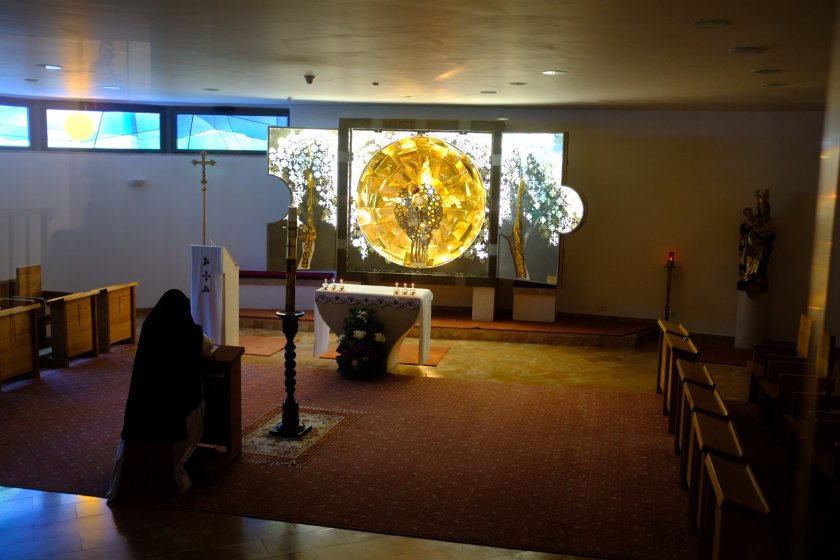
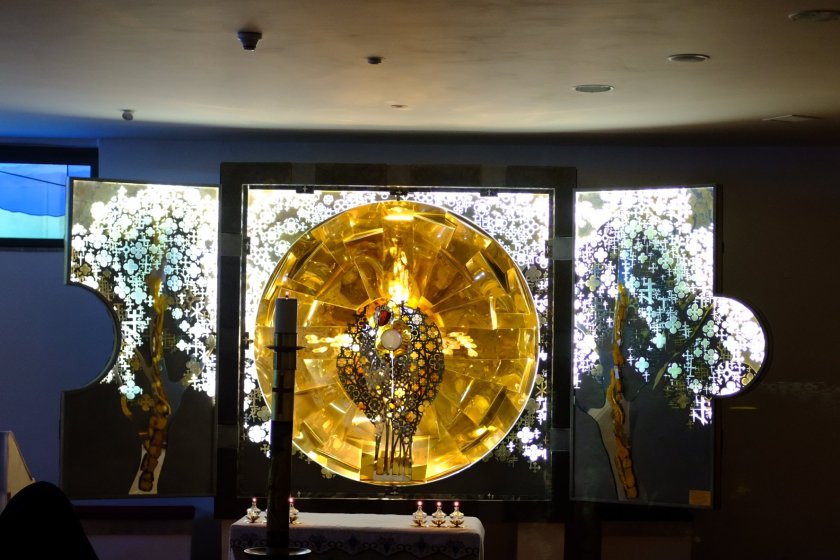
One of the most beautiful chapels. A Sister Nun is always present, praying.

Close up of the Blessed Sacrament on display.

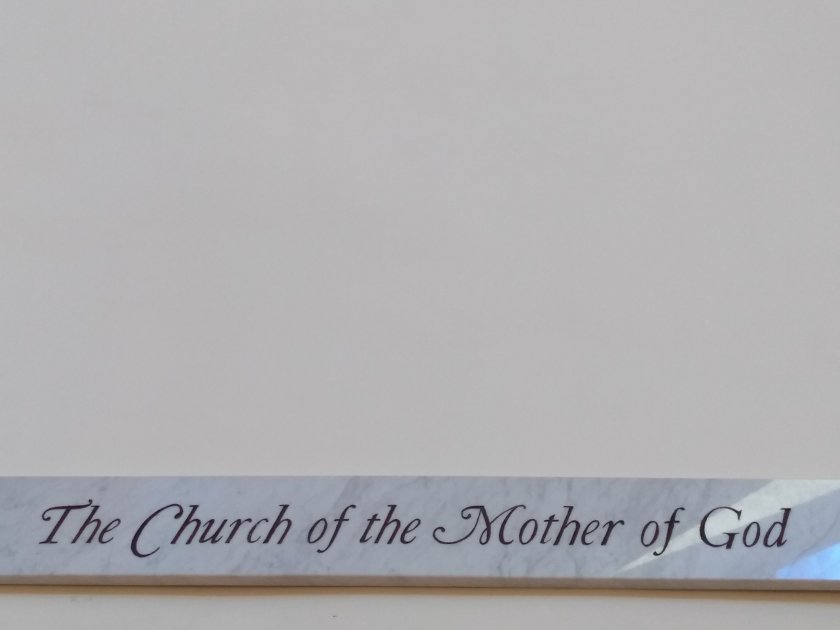
We celebrated Mass at this Church of the Mother of God.

This amazing day, like the others was just getting started. Due to some concerns, the afternoon itinerary was adjusted and we made a trip to Masada. This is a must see as this was King Herod’s winter palace.

We passed the Dead Sea and Wadi Qumran (where the scrolls were found) on the way to Masada. Former continues to drop 1 foot each year.

Masada is a fortress palace. It’s also known as the place where the second Jewish uprising ended with the suicide of all the Jews inside, except for 5 children and 2 women who hid themselves. The alternative facing these freedom fighters was slavery. The Romans were known for their cruelty as they imposed order across their empire (crucified rebels took days to die an excrutiating death).

The King’s bedroom, bathroom, living quarters are located for stupendous views across the valley (from 500 feet above).

Oh, the King lived like a king. They found wine bottles and mosaic tiles from Italy.

We saw many (young ones) who decided to walk up to the complex via the ‘snake path’ rather than take the cable car!

There’s much architectural thought that went into the design of the complex that one can spend hours here. How they captured rain from the surrounding hills and mountains via ducts that drain into water cisterns, and subsequently, use donkeys to ferry up and store in the complex itself. There’s a cast model to show this water collection!

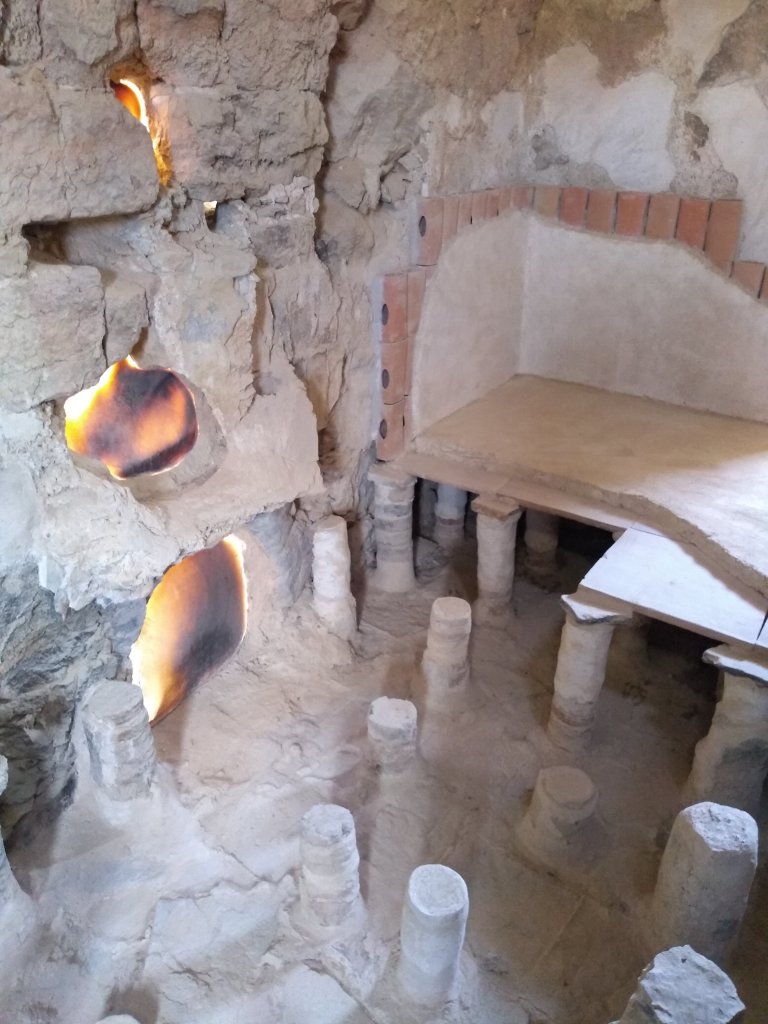
The steam rooms’ floor rest on top of supports. Water is ducted into the steam room, vaporized by a heat source and conducted into the ceiling area by hollow tiles on the side. Finally, the ceiling is domed so that water doesn’t drop on you! Aha, that’s why the old Turkish bath houses had a dome!

Cast model of the fortress palace

Steam room

View across the valley

The squarish demarcation of one of the Roman camps during the siege. This was the largest camp which the Roman general was based in.

Ruins in the complex

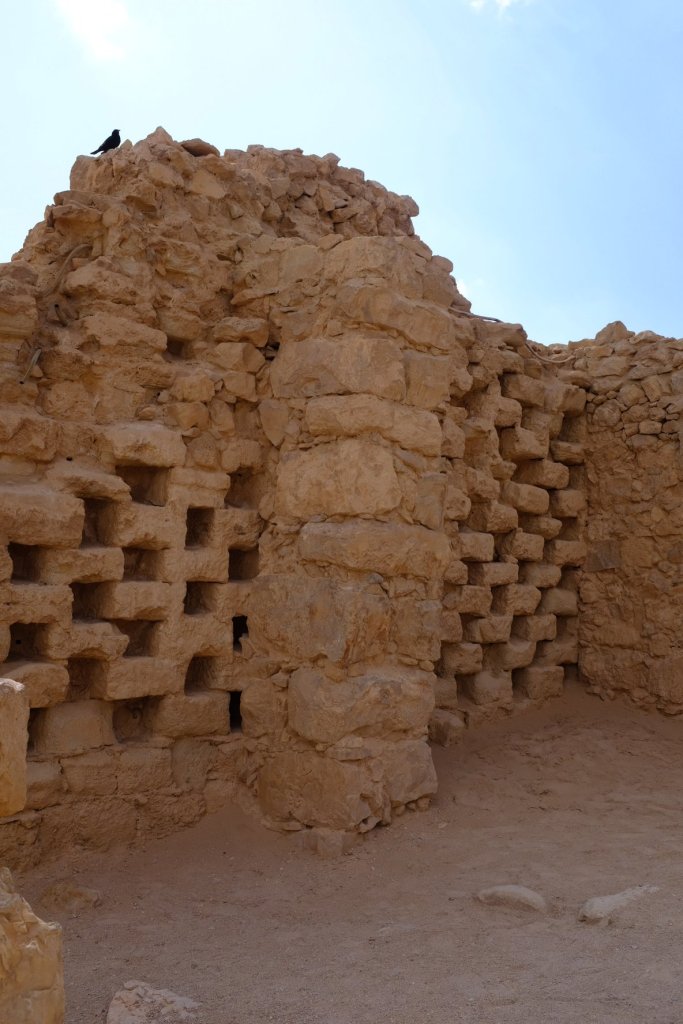
Pigeons were kept for food and their poop used as fertilizer for the vegetable gardens

Our day was completed by having dinner with local Christian families who are to host us. This is a real treat eating home cooked meals and hearing their stories.

At dinner, something occurred that deepened my self awareness post event. I was missing a glass for the beverage. Mid dinner, as I topped up a companion’s glass, another companion took an empty glass from an unoccupied seating. I interpreted that she was passing the glass to me for my own use. So, I filled it up and set it next to my plate. I don’t recall what the trigger was, but I suddenly realized that she herself was missing a glass and had wanted it filled for herself. Of course, I immediately passed to her and our host got up to get one more glass. The insight occurred to me the next morning.

When we have a need, and the ‘solution’ appears, we quickly reach for it. Perhaps we should slow down and see if someone else is in similar or greater need.

Kudos to our tour company, the Holy Land Tours, for rapidly responding to on the ground circumstances, offering an alternative that was much better and creating that local connection with families.